Other Briefings
UK-GCC Free Trade Agreement (FTA): Key Provisions and Business Implications for the Gulf
The United Kingdom and the Gulf Cooperation Council (GCC) concluded negotiations on a landmark free trade agreement (FTA) on May 20, 2026, marking a significant step in the development of UK-Gulf economic relations. The agreement covers the six GCC member states (Bahrain, Kuwait, Oman, Qatar, Saudi Arabia, and the United Arab Emirates) and is the first free trade agreement concluded between the GCC as a bloc and a Group of Seven economy.

The agreement comes at a time when the GCC economies are pursuing long-term diversification strategies, including Saudi Arabia’s Vision 2030, the UAE’s “We the UAE 2031” agenda, Oman Vision 2040, Qatar National Vision 2030, Bahrain Economic Vision 2030, and Kuwait Vision 2035. These national plans are driving investment in infrastructure, logistics, financial services, clean energy, healthcare, education, technology, and advanced industries, sectors where the UK has established commercial strengths.
UK-GCC FTA in brief
The GCC-UK FTA creates a broad trade and investment framework covering goods, services, investment, digital trade, and business mobility. Once implemented, the agreement is expected to improve market access, reduce tariff and non-tariff barriers, and make GCC-UK trade routes more efficient for businesses operating across both markets.
Key commercial features of the agreement include:
- Tariff liberalization: The agreement is expected to remove tariffs on approximately 93 percent of current UK goods exports to the GCC over time. Once fully implemented, this could eliminate around £580 million (approximately US$778 million) in annual duties, with a significant share of tariff reductions applying from the date the FTA enters into force.
- Bilateral trade growth: The UK government estimates that the agreement could increase GCC-UK bilateral trade by 19.8 percent in the long run, equivalent to around £15.5 billion (approximately US$20.8 billion) annually.
Beyond tariff reductions, the FTA is expected to simplify customs procedures and support faster, more predictable clearance processes. By reducing documentation requirements and improving transparency at the border, the agreement could help companies lower administrative costs, shorten clearance times, and strengthen supply chain planning.
Several goods sectors are expected to benefit from improved tariff treatment, including:
- Automotive;
- Advanced manufacturing;
- Aerospace;
- Electronics; and
- Food and beverage.
The agreement also includes commitments that go beyond trade in goods. These cover the free flow of data, stronger access for financial and professional services providers, investment protection, business mobility, and cooperation on the recognition of professional qualifications. Together, these provisions position the FTA as a wider commercial platform for deeper GCC-UK economic engagement.
UK-GCC bilateral trade relations
The UK-GCC trade relationship is already substantial. Total trade between the UK and GCC countries is valued at around GBP 53 billion (approximately US$71.6 billion). The UK government estimates that the FTA could increase bilateral trade by 19.8 percent in the long run, potentially adding around GBP 15.5 billion (US$20.9 billion) annually compared with 2040 projections. The agreement is also projected to add GBP 3.7 billion (US$5.0 billion) to the UK economy each year in the long term and increase real wages by GBP 1.9 billion (US$2.6 billion) annually.
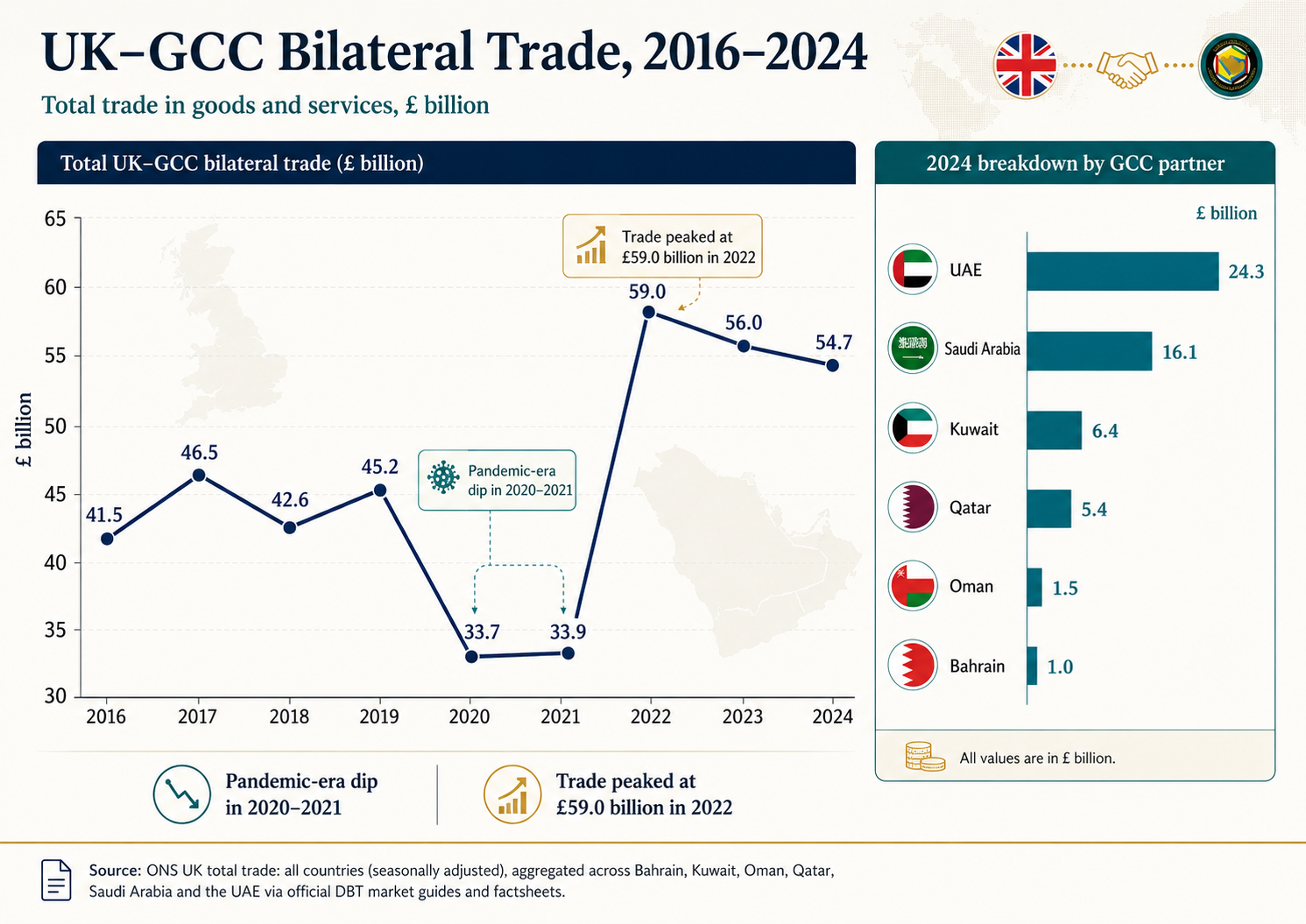
While these figures are forecasts and will depend on implementation, market conditions, and business uptake, they indicate the expected scale of the agreement’s impact:
- For the GCC, the deal strengthens access to a major services, finance, education, healthcare, and technology market; while
- For the UK, it improves market access to a region with high import demand, significant sovereign wealth, and large-scale transformation programs.
The agreement also comes at a time when the GCC is expanding its trade architecture. The bloc has previously concluded FTAs with Singapore (GCC-Singapore Free Trade Agreement) and the European Free Trade Association (EFTA–GCC Free Trade Agreement), while individual GCC members have pursued their own bilateral trade agreements and comprehensive economic partnership agreements. The UK-GCC FTA adds a major G7 partner to this network and gives the Gulf a broader platform for commercial engagement with the UK market.
This will improve the competitiveness of UK goods in GCC markets, especially in sectors where tariffs have historically added costs for importers, distributors, retailers, and consumers. Key beneficiary sectors include:
- Advanced manufacturing;
- Aerospace;
- Automotive;
- Machinery;
- Electronics;
- Life sciences;
- Healthcare;
- Agri-food;
- Personal care; and
- Consumer goods.
In advanced manufacturing, the agreement is expected to remove tariffs on products such as turbojets, aerospace parts, machinery, electronics, internal combustion engines, valves, and centrifuges. Automotive exporters will also benefit, with full tariff elimination for UK passenger cars. A large share of existing UK car exports to the GCC, including hybrids, is expected to become tariff-free at entry into force, while electric vehicles and electric batteries will become tariff-free after a 10-year period.
The healthcare and life sciences sectors are also expected to gain from the removal of tariffs on medical devices, including surgical instruments and radiological devices. This is relevant for GCC markets that continue to expand healthcare infrastructure, medical technology capacity, and private sector participation in health services.
Agri-food is another important area. The Gulf is a net food-importing region, and UK food and drink exports to the GCC are already significant. Products such as cheddar cheese, chocolate, biscuits, Scottish smoked salmon, pet food, and animal feed are expected to benefit from tariff removal. This could support UK exporters while expanding product availability for Gulf distributors, retailers, hotels, restaurants, and food service operators.
The UK, in turn, will liberalize tariffs on all current GCC exports to the UK from day one of the agreement’s entry into force. This could make GCC-origin products more competitive in the UK market, although oil and gas (among the region’s major exports) already generally face low or no tariff barriers. The agreement excludes pork, chicken, and eggs from UK tariff liberalization.
UK-GCC FTA overview
Rules of origin: Qualification for preferential tariffs
Rules of origin will determine which products qualify for preferential tariff treatment under the UK-GCC FTA. Goods must be either wholly obtained or sufficiently transformed in the UK or the GCC, while still allowing businesses to use international supply chains where the relevant origin criteria are met.
The agreement also allows UK exporters to self-certify origin documentation after registration, reducing administrative burdens. Businesses importing or exporting under the FTA should review product classifications, supplier documentation, origin records, and internal compliance processes before the agreement enters into force.
Customs and trade facilitation
The FTA includes commitments to make customs procedures more efficient, transparent, and predictable. Compliant goods are expected to clear customs within 48 hours, while perishable goods may clear within six hours, provided all documentation requirements are met and no physical checks are required.
Businesses will also be able to request advance rulings on tariff classification, valuation, and origin, helping reduce uncertainty before shipment. To benefit from faster clearance, companies should ensure that HS codes, valuation methods, origin documentation, and customs records are accurate and up to date.
Services and financial services
The agreement provides greater certainty for service providers across sectors such as legal services, engineering, construction, consulting, education, healthcare, telecommunications, technology, and financial services. It is designed to improve transparency around licensing and authorization procedures while limiting future restrictions on market access.
Financial services are a key area of the deal. The FTA includes commitments protecting the free flow of financial data and prohibiting unjustified data localization requirements. This is particularly relevant for financial centers such as the DIFC and ADGM, as well as fintech, insurance, asset management, and professional services providers operating across the UK and GCC.
Professional mobility and qualifications
The FTA includes business mobility commitments covering business visitors, contractual service suppliers, intra-company transferees, investors, and professionals. These provisions should support project delivery, client servicing, regional operations, and cross-border professional work.
The agreement also encourages discussions on the recognition of professional qualifications, including in fields such as engineering, architecture, accounting, and law. However, recognition will not be automatic, and professional regulators will continue to set their own standards.
Digital trade, data, and paperless commerce
The digital trade chapter supports paperless trade, electronic trade documents, electronic bills of lading, open internet access, online consumer protection, and cooperation on emerging technologies such as artificial intelligence.
A major feature is the prohibition of unjustified data localization requirements, which supports cross-border data flows for businesses using cloud services, fintech platforms, digital trade systems, and integrated supply chains. The agreement also includes protections against forced disclosure of source code or cryptographic information.
Telecommunications and regulatory cooperation
The telecommunications provisions aim to ensure fair and regulated access to GCC telecoms networks and services. They include commitments on licensing, interconnection, access to infrastructure, allocation of scarce resources, and non-discriminatory treatment of overseas suppliers.
These provisions are relevant for businesses operating in digital infrastructure, cloud services, fintech, e-commerce, artificial intelligence, and smart city development across the Gulf.
Public procurement: UAE and Bahrain commitments
The procurement chapter creates new opportunities for UK suppliers in covered public procurement markets, particularly in the UAE and Bahrain. It establishes commitments to fair, transparent, and non-discriminatory treatment in eligible government contracts.
In the UAE, UK suppliers will gain access to covered federal procurement opportunities and may apply for In-Country Value supplier certification, which can provide an advantage in certain tenders. Businesses should still review sector coverage, thresholds, registration requirements, and tender rules before pursuing procurement opportunities.
Investment protections and dispute settlement
The FTA includes investment protections intended to provide greater certainty for UK and GCC investors. These include protections against discriminatory treatment and access to investor-state dispute settlement for qualifying treaty claims.
The framework may support long-term investment in sectors such as infrastructure, energy, logistics, financial services, healthcare, education, technology, and real estate. Investors should review how the FTA interacts with existing bilateral investment treaties, including the UK-UAE treaty, which remains in place.
Intellectual property and enforcement
The agreement covers copyright, trademarks, designs, patents, trade secrets, geographical indications, enforcement, and cooperation. It also reinforces commitments under key international intellectual property treaties and the WTO TRIPS Agreement.Stronger enforcement provisions may benefit SMEs, creative industries, life sciences companies, technology firms, consumer brands, and manufacturers seeking protection against counterfeiting, online infringement, and unauthorized use of intellectual property.
Anti-corruption, sustainability, and inclusive growth
The FTA includes provisions on anti-corruption, responsible business conduct, women’s economic empowerment, sustainable development, responsible gold trade, and regulatory transparency.
These provisions reflect the broader direction of modern trade agreements, which increasingly combine market access with governance, inclusion, and long-term economic resilience.
Key takeways
The GCC-UK FTA, concluded on May 20, 2026, will take effect only once the required ratification procedures have been completed. Ahead of implementation, companies engaged in GCC-UK trade should begin assessing how the agreement may affect their operations, including potential tariff savings, supply chain planning, customs processes, and market access opportunities.
Businesses should consider the following preparatory steps:
- Review HS classifications and origin criteria to determine which products may be eligible for preferential tariff treatment.
- Map existing supply chains and sourcing arrangements to identify where the agreement could improve cost efficiency or support stronger GCC-UK trade flows.
- Assess internal compliance systems, documentation processes, and supplier records to ensure readiness for origin-related requirements.
- Track the rollout of tariff schedules, customs procedures, rules of origin, and other technical provisions, as these will determine how the FTA is applied in practice.
- Prepare for possible differences in interpretation, administration, or implementation timelines across GCC member states, particularly where national customs authorities are responsible for enforcement.
About Us
Middle East Briefing is one of five regional publications under the Asia Briefing brand. It is supported by Dezan Shira & Associates, a pan-Asia, multi-disciplinary professional services firm that assists foreign investors throughout Asia, including through offices in Dubai (UAE). Dezan Shira & Associates also maintains offices or has alliance partners assisting foreign investors in China (including the Hong Kong SAR), Indonesia, Singapore, Malaysia, Mongolia, Japan, South Korea, Nepal, The Philippines, Sri Lanka, Thailand, Italy, Germany, Bangladesh, Australia, United States, and United Kingdom and Ireland.
For a complimentary subscription to Middle East Briefing’s content products, please click here. For support with establishing a business in the Middle East or for assistance in analyzing and entering markets elsewhere in Asia, please contact us at dubai@dezshira.com or visit us at www.dezshira.com.
- Previous Article UAE Salary Payment Rules Tighten from June 1, 2026: What Employers Should Know
- Next Article Setting Up a Business in Dubai: A 2026 Guide