Other Briefings
Saudi Arabia Hiring Guide: Employment Contracts, Saudization, Probation, and Probation Rules
Foreign employers hiring in Saudi Arabia must comply with Labor Law requirements, Saudization quotas, Qiwa employment contracts, probation rules, and restrictions on foreign workers and independent contractors.
Saudi Arabia’s labor market is becoming more structured, digitalized, and nationalization-driven as the Kingdom continues to expand its private sector under Vision 2030.
For foreign companies entering or scaling operations in Saudi Arabia, hiring employees requires more than selecting candidates and issuing offer letters. Employers must consider labor law requirements, Saudization obligations, electronic contract registration, work authorization, and the legal distinction between employees, contractors, and temporary workers.
This article outlines the key rules employers should understand when hiring employees in Saudi Arabia, including anti-discrimination requirements, Saudization and Nitaqat compliance, written employment contracts, fixed-term arrangements, probation periods, contractor classification, and temporary staffing.
Legal framework for hiring in Saudi Arabia
Employment relationships in Saudi Arabia are primarily governed by the Saudi Labor Law and related implementing regulations. In practice, hiring is also administered through official digital platforms, including Qiwa, which is used for employment contract management and other labor-market services.
For employers, this means that hiring is both a contractual and regulatory process. A company must ensure that the employment relationship is properly documented, that the employee has the right to work, and that the hire does not create Saudization or work permit issues.
Equal opportunity and anti-discrimination
Saudi Labor Law provides that citizens have an equal right to work and prohibits discrimination based on gender, disability, age, or other discriminatory grounds in employment, job performance, and job advertising.
Employers should therefore ensure that recruitment processes are based on objective and role-related criteria. Job advertisements, interviews, salary offers, and promotion decisions should be consistent, documented, and free from discriminatory language or requirements.
At the same time, employers must also comply with Saudization rules, which require private-sector companies to employ Saudi nationals at levels determined by their activity and size. These requirements form a core part of workforce planning in the Kingdom.
Saudization and the Nitaqat system
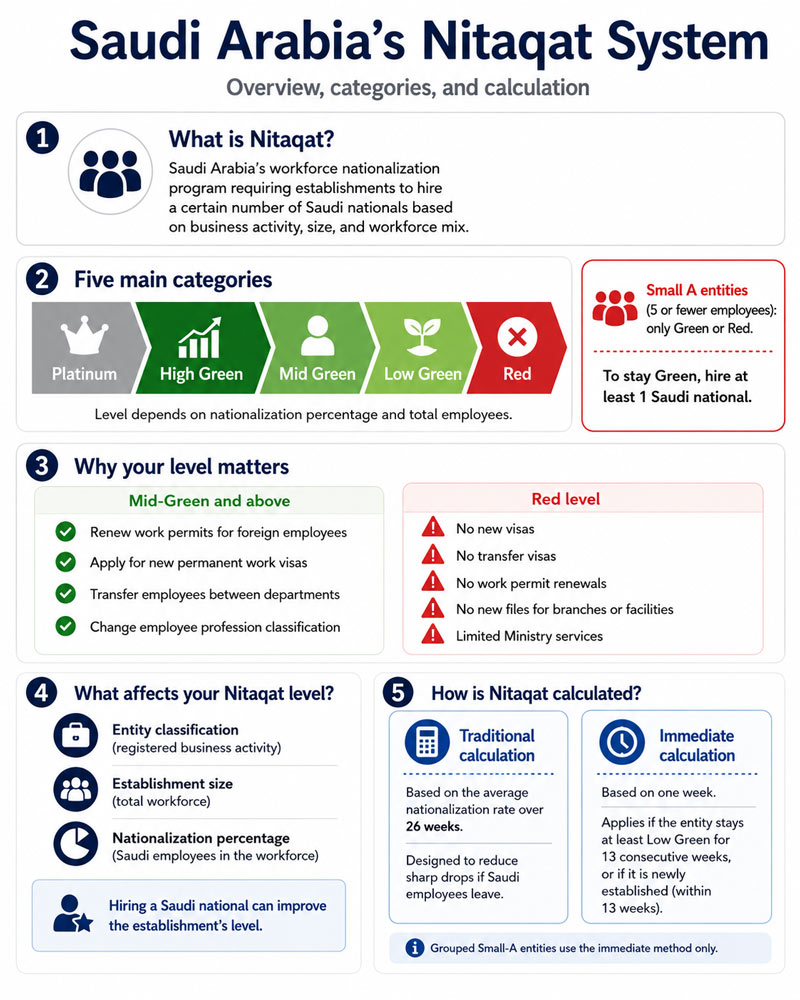
Saudization is a central compliance issue for companies operating in Saudi Arabia. Under the Nitaqat system, companies are classified according to their level of Saudi national employment. The applicable Saudization requirement depends on the company’s licensed activity, headcount, and classification.
Companies are generally placed into categories such as Red, Low Green, Medium Green, High Green, and Platinum. These categories affect an employer’s ability to access labor-market services. A Red rating can restrict a company’s ability to recruit foreign employees, renew work permits, or transfer foreign workers. Low Green may technically indicate compliance, but it can still limit access to new visas or changes to foreign workers’ professions. Medium Green or higher is usually a more practical target for employers planning to expand.
For foreign companies, Saudization should be assessed before recruitment begins. Hiring foreign nationals without reviewing the company’s Nitaqat status may later affect the employer’s ability to renew permits, transfer employees, or support future growth.
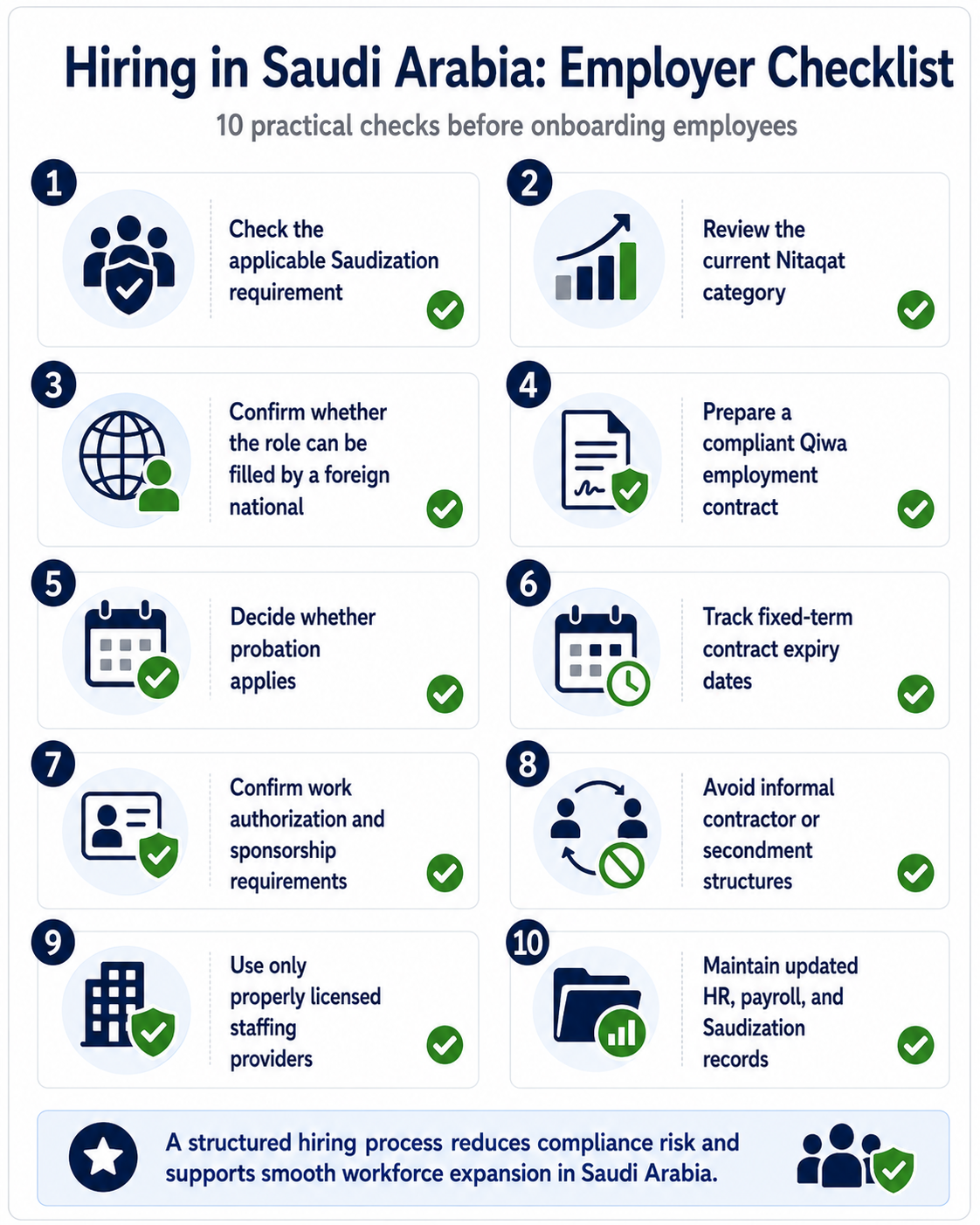
Before hiring, employers should ask:
- What is the company’s licensed activity?
- Which Saudization requirement applies?
- What is the current Nitaqat category?
- Will the proposed hire affect the company’s rating?
- Can the company continue to obtain and renew foreign worker permits?
Written employment contracts and Qiwa
Saudi Labor Law requires employment contracts to be in writing. In practice, electronic employment contracts are now central to hiring in Saudi Arabia. Local hires, whether Saudi or foreign, are generally onboarded through contracts prepared and accepted through Qiwa.
A Qiwa employment contract typically includes:
- Job title;
- Contract term;
- Renewal provisions;
- Probation period;
- Working hours;
- Rest days;
- Annual leave;
- Wages;
- Benefits;
- Employer obligations;
- Employee obligations;
- Applicable law; and
- Jurisdiction.
Employers may also add clauses where needed, including confidentiality, intellectual property, non-compete, and provisions on bonuses or commissions.
Employees accept, reject, or request changes to the contract through the platform. For foreign workers hired from abroad, employers may use a paper contract during the visa process. However, once the employee enters Saudi Arabia and obtains the relevant work and residency permit, the employer must complete the Qiwa contract process.
Lastly, employers should ensure that the Qiwa contract reflects the actual commercial terms agreed with the employee. Differences between an offer letter, overseas contract, and Qiwa contract can create legal uncertainty.
Fixed-term and indefinite contracts
The type of employment contract available in Saudi Arabia depends partly on the employee’s nationality.
Foreign national employees must be hired on fixed-term contracts. There is no general minimum or maximum term, although one-year contracts are common in practice. If no term is specified, the contract may be treated as running for one year from the employee’s actual start date. If employment continues after expiry, the contract may be treated as renewed for a similar period.
Saudi and GCC nationals may be employed on either fixed-term or indefinite contracts. However, repeated renewal of a fixed-term contract, or continued performance after expiry, may cause the contract to become indefinite in certain circumstances.
Employers should maintain a contract register tracking start dates, expiry dates, renewal provisions, probation periods, and notice requirements. This is especially important for companies with large expatriate workforces.
Probation periods
Probation is permitted in Saudi Arabia but must be expressly stated in the employment contract. Employers cannot rely on probationary termination rights if probation has not been properly included.
The probation period cannot exceed 180 calendar days. Public holidays and sick leave are excluded from the calculation. The parties may agree to a shorter probation period and may extend it by written agreement, provided the total period does not exceed the legal maximum.
Either party may terminate the contract during probation. However, employers should still document performance concerns, probation reviews, and termination decisions to reduce dispute risk.
Employers using probation should:
- Include the probation clause in the contract;
- State the exact probation period;
- Track the probation end date;
- Document any extension in writing;
- Ensure the total period does not exceed 180 calendar days; and
- Review performance before the probation period expires.
Hiring foreign employees
Foreign nationals working in Saudi Arabia must generally be employed, sponsored, and paid by the same employer. They may not work for another entity unless a valid legal arrangement applies.
This is important for group companies, secondments, temporary staffing, and project-based work. Employers should avoid informal arrangements where a foreign national is sponsored by one company but works in practice for another. Such arrangements may create labor and immigration risks.
Before hiring a foreign worker, employers should confirm that the company can sponsor the employee, obtain or transfer the relevant work authorization, and maintain compliance with Saudization requirements.
Employees, contractors, and classification risk
Foreign companies often consider using consultants or contractors before building a local workforce. In Saudi Arabia, this requires careful structuring.
A genuine independent contractor should not be registered as an employee on the company’s Qiwa or social insurance records. The contractor should usually operate through a properly licensed Saudi individual or entity, provide services independently, and avoid employee-style benefits such as paid leave, allowances, or a monthly salary.
If a contractor works exclusively for the company, uses a company email address, receives employee-style benefits, works under direct supervision, and is integrated into the organization, the relationship may be treated as employment. This can expose the company to wage, benefit, end-of-service, and social insurance obligations.
The risk is higher for foreign nationals residing in Saudi Arabia, who generally cannot work as self-employed contractors unless a specific legal basis applies.
Temporary staffing and manpower agencies
Employers may use manpower companies or staffing agencies for temporary or project-based workforce needs. However, they should verify that the provider is properly licensed.

Not every company presenting itself as a manpower or recruitment provider is authorized to supply workers. Where foreign workers are deployed to another company’s premises, the arrangement may need to be documented through Ajeer or another valid legal mechanism. Before using a staffing provider, employers should confirm the provider’s license, sponsorship arrangements, payroll responsibilities, work permit status, and liability for labor law violations.
Conclusion
Saudi Arabia offers significant opportunities for foreign employers, but hiring in the Kingdom requires careful legal and operational planning. Companies must align recruitment with labor law, Saudization rules, Qiwa contract procedures, work authorization requirements, and lawful staffing structures.
Employers that treat hiring as a compliance process from the beginning will be better positioned to scale their workforce, access foreign talent where permitted, and avoid regulatory disruption.
How Dezan Shira & Associates can help
Hiring in Saudi Arabia requires careful coordination between labor law compliance, Saudization planning, employment contract preparation, work authorization, and payroll administration. For foreign employers, even routine hiring decisions can affect Nitaqat status, access to foreign worker permits, and the ability to scale operations smoothly in the Kingdom.
Dezan Shira & Associates supports companies in structuring compliant hiring processes in Saudi Arabia, including workforce planning, HR and payroll setup, employment contract review, Saudization compliance, and ongoing labor law advisory. Our team helps businesses align recruitment and onboarding practices with local requirements, reducing compliance risk while supporting long-term workforce growth. To arrange a consultation, please contact our local advisory team.
About Us
Middle East Briefing is one of five regional publications under the Asia Briefing brand. It is supported by Dezan Shira & Associates, a pan-Asia, multi-disciplinary professional services firm that assists foreign investors throughout Asia, including through offices in Dubai (UAE). Dezan Shira & Associates also maintains offices or has alliance partners assisting foreign investors in China (including the Hong Kong SAR), Indonesia, Singapore, Malaysia, Mongolia, Japan, South Korea, Nepal, The Philippines, Sri Lanka, Thailand, Italy, Germany, Bangladesh, Australia, United States, and United Kingdom and Ireland.
For a complimentary subscription to Middle East Briefing’s content products, please click here. For support with establishing a business in the Middle East or for assistance in analyzing and entering markets elsewhere in Asia, please contact us at dubai@dezshira.com or visit us at www.dezshira.com.
- Previous Article France-UAE Business Ties: Why French Companies Are Expanding in the UAE
- Next Article Severance Pay and Taxation for Expats Leaving the UAE