Other Briefings
AI-Enabled Service Bundling in the Middle East: New Growth Opportunities for Businesses
AI-enabled service bundling is helping Middle East businesses improve customer retention, reduce operating costs, and create recurring revenue models through integrated digital services.
Artificial intelligence (AI) is becoming a practical growth tool for businesses across the Middle East, particularly in the Gulf Cooperation Council (GCC), as companies look for ways to improve customer retention, reduce operating costs, and create new revenue streams. One emerging opportunity is AI-enabled service bundling, where companies combine related services into integrated digital offerings supported by automation, analytics, and customer data.

Businesses can use AI to connect services such as customer support, payments, compliance, cloud infrastructure, cybersecurity, and back-office operations. This model is particularly relevant for sectors such as telecom, banking, healthcare, and software-as-a-service, where companies already manage large customer bases and recurring service relationships.
For foreign investors and technology providers, AI-enabled bundling offers a way to move beyond basic digital transformation projects and support more scalable business models. Still, success will depend on localization, data governance, regulatory compliance, and sector-specific partnerships.
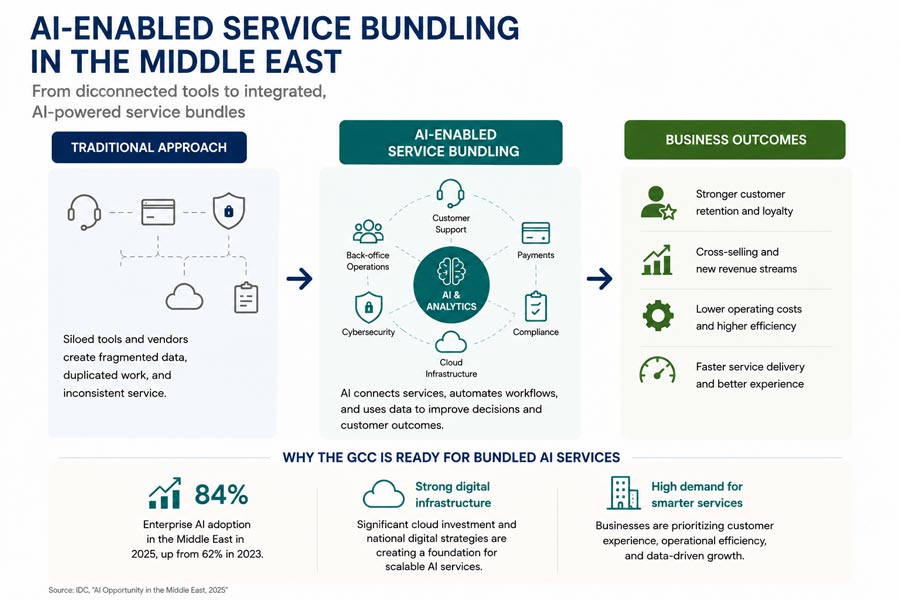
What is AI-enabled service bundling?
AI-enabled service bundling refers to the use of artificial intelligence to combine related business services into integrated, data-driven offerings. In this context, bundling does not simply mean selling several products together at a discount, as is common in telecom or retail pricing. It means connecting services such as customer support, cloud infrastructure, cybersecurity, payments, compliance, analytics, and back-office operations into a coordinated service model.
For businesses, the value lies in reducing fragmentation. Many companies still rely on separate vendors, platforms, and internal teams to manage different parts of the customer or operational journey. This can create duplicated workflows, disconnected data systems, inconsistent service quality, and slower decision-making. AI can help address these challenges by automating routine tasks, analyzing customer and operational data, and improving coordination across functions. The commercial goal is to improve retention, enable cross-selling, reduce operating costs, and deliver services faster.
Why the GCC is ready for bundled AI services
The GCC is increasingly well positioned for AI-enabled bundled services, supported by national digital strategies, cloud investment, and demand for smarter public and private-sector services. Enterprise AI adoption has climbed from 62 percent in 2023 to 84 percent in 2025, and companies are looking for applications that improve customer experience, operational efficiency, and revenue generation.
However, adoption remains uneven. Large enterprises and government-linked entities are often better placed to invest in AI, automation, and cloud platforms, while many smaller businesses remain at the pilot or partial implementation stage. This creates an opening for providers that can connect separate tools into practical service bundles. Instead of adopting standalone AI applications for customer service, compliance, payments, cybersecurity, or analytics, companies can work with providers that integrate these functions into one operating model. For foreign providers, market readiness will depend on local compliance, data governance, cloud requirements, Arabic-language capabilities, and partnerships with regional technology, telecom, payments, and compliance players.
Where service bundling can create value
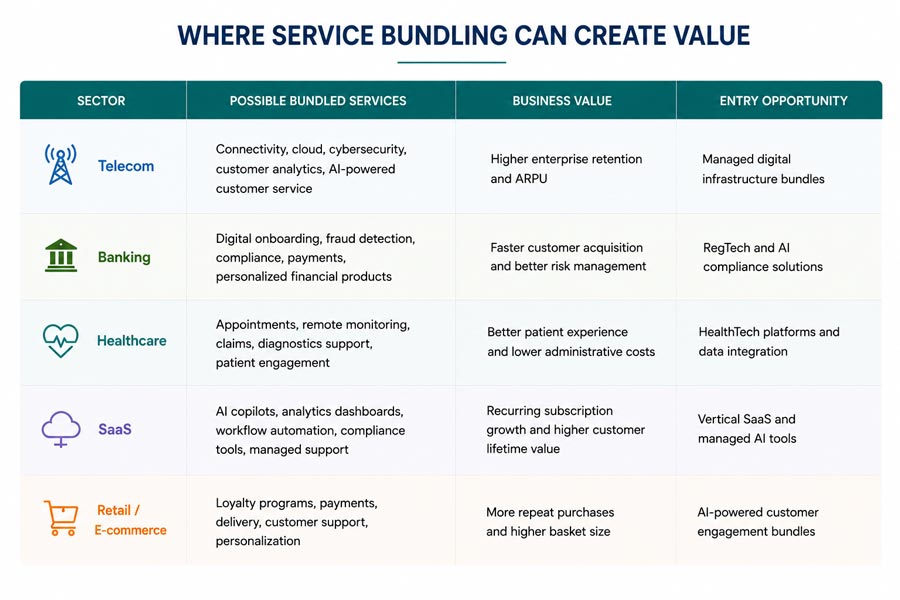
AI-enabled service bundling can create value in sectors that manage large customer bases, recurring service relationships, and complex operational workflows. Telecom operators can combine connectivity, cloud services, cybersecurity, customer analytics, and AI-supported customer service into enterprise bundles. This can help them move beyond basic connectivity and become broader digital infrastructure partners. Combined telecom cloud and managed services revenue at e&, stc, Ooredoo, Zain, and du exceeded 55 percent of total regional telecom cloud revenue in 2024, reflecting how far regional operators have already moved into adjacent service categories.
Banks can use bundled services to connect digital onboarding, fraud monitoring, compliance workflows, payments, and personalized financial products. These tools can improve customer acquisition while helping institutions manage regulatory and risk requirements. In healthcare, providers can integrate appointments, remote monitoring, claims handling, diagnostics support, and patient engagement, creating smoother patient journeys and reducing administrative pressure. Software-as-a-service (SaaS) companies can also bundle AI copilots, analytics dashboards, workflow automation, compliance tools, and managed support. Across these sectors, the strongest opportunities will appear where customer data, compliance needs, and fragmented service delivery overlap.
| AI-Enabled Service Bundling Opportunities in the GCC | |||
| Sector | Possible bundled services | Business value | Entry opportunity |
| Telecom | Connectivity, cloud, cybersecurity, customer analytics | Higher enterprise retention | Managed digital infrastructure bundles |
| Banking | Digital onboarding, fraud detection, compliance, payments | Faster customer acquisition | Regulatory technology (regtech) and AI compliance solutions |
| Healthcare | Appointments, remote monitoring, claims, patient engagement | Better patient experience | Health technology (healthtech) platforms and data integration |
| SaaS | AI copilots, dashboards, workflow automation, support | Recurring subscription growth | Vertical SaaS and managed AI tools |
| Retail/e-commerce | Loyalty, payments, delivery, customer support | More repeat purchases | AI-powered customer engagement bundles |
What foreign providers should verify before entering the market
Foreign providers should assess the regulatory and commercial environment before launching AI-enabled bundled services in the GCC. Data protection, cloud licensing, cross-border data transfer rules, cybersecurity obligations, and sector-specific compliance requirements can affect how services are designed, hosted, and delivered. This is especially important in regulated sectors such as banking, healthcare, telecom, and government services, where customer data and operational continuity are sensitive.
Providers should also map where bundled services can solve a clear business problem. The strongest opportunities are not always in adding more tools, but in improving one fragmented customer or operational journey. For example, a bank may need a smoother onboarding and compliance process, while a healthcare provider may need better coordination between appointments, claims, and patient engagement.
Local partnerships will also be important. Cloud providers, telecom operators, payment platforms, cybersecurity firms, and compliance advisors can help foreign entrants localize their offering, meet regulatory expectations, and close capability gaps.
How to position the offering and structure revenue
Bundled services should be positioned as a long-term operating solution rather than a one-off technology implementation. Foreign providers can create more durable revenue models by offering recurring managed services, subscription-based platforms, or performance-linked service packages.
This approach is better aligned with how AI systems create value over time, through continuous optimization, data improvement, and integration with client workflows.
The most attractive opportunities will sit at the overlap of customer data, compliance needs, and fragmented service delivery. Providers should therefore avoid broad, generic AI offerings and focus on specific pain points where bundling creates measurable value. Examples include customer onboarding, fraud monitoring, enterprise cloud management, cybersecurity, patient engagement, and AI-supported back-office functions.
At the same time, providers should avoid overpromising. Explainable AI, human oversight, clean data foundations, and clear governance processes should be built into the offer from the start. This can reduce operational risk, protect trust, and strengthen long-term client relationships.
Key takeaways
AI-enabled service bundling is emerging as a practical growth lever for GCC economies moving past pilot-stage AI adoption toward commercial outcomes. The opportunity is regional in scope but uneven in maturity, with the UAE and Saudi Arabia setting the pace on enterprise AI adoption while smaller GCC markets may offer more targeted opportunities in regulated or high-growth sectors. For GCC businesses, bundling enables a shift from discrete digital products to integrated services that deepen customer relationships.
For foreign providers, the entry playbook rests on three pillars. Sector selectivity matters, as telecom, banking, healthcare, and software-as-a-service each reward different capability mixes. Local integration matters as much as underlying AI capability, since success depends on connecting with regional cloud, payments, compliance, and trusted partners. Long-term positioning matters too, because bundled service models compound over time, and providers prioritizing durable client relationships over quick implementation wins will be better positioned as GCC enterprise AI adoption scales.
About Us
Middle East Briefing is one of five regional publications under the Asia Briefing brand. It is supported by Dezan Shira & Associates, a pan-Asia, multi-disciplinary professional services firm that assists foreign investors throughout Asia, including through offices in Dubai (UAE). Dezan Shira & Associates also maintains offices or has alliance partners assisting foreign investors in China (including the Hong Kong SAR), Indonesia, Singapore, Malaysia, Mongolia, Japan, South Korea, Nepal, The Philippines, Sri Lanka, Thailand, Italy, Germany, Bangladesh, Australia, United States, and United Kingdom and Ireland.
For a complimentary subscription to Middle East Briefing’s content products, please click here. For support with establishing a business in the Middle East or for assistance in analyzing and entering markets elsewhere in Asia, please contact us at dubai@dezshira.com or visit us at www.dezshira.com.