Other Briefings
How to Choose the Right UAE Free Zone: Practical Guide for Foreign Investors
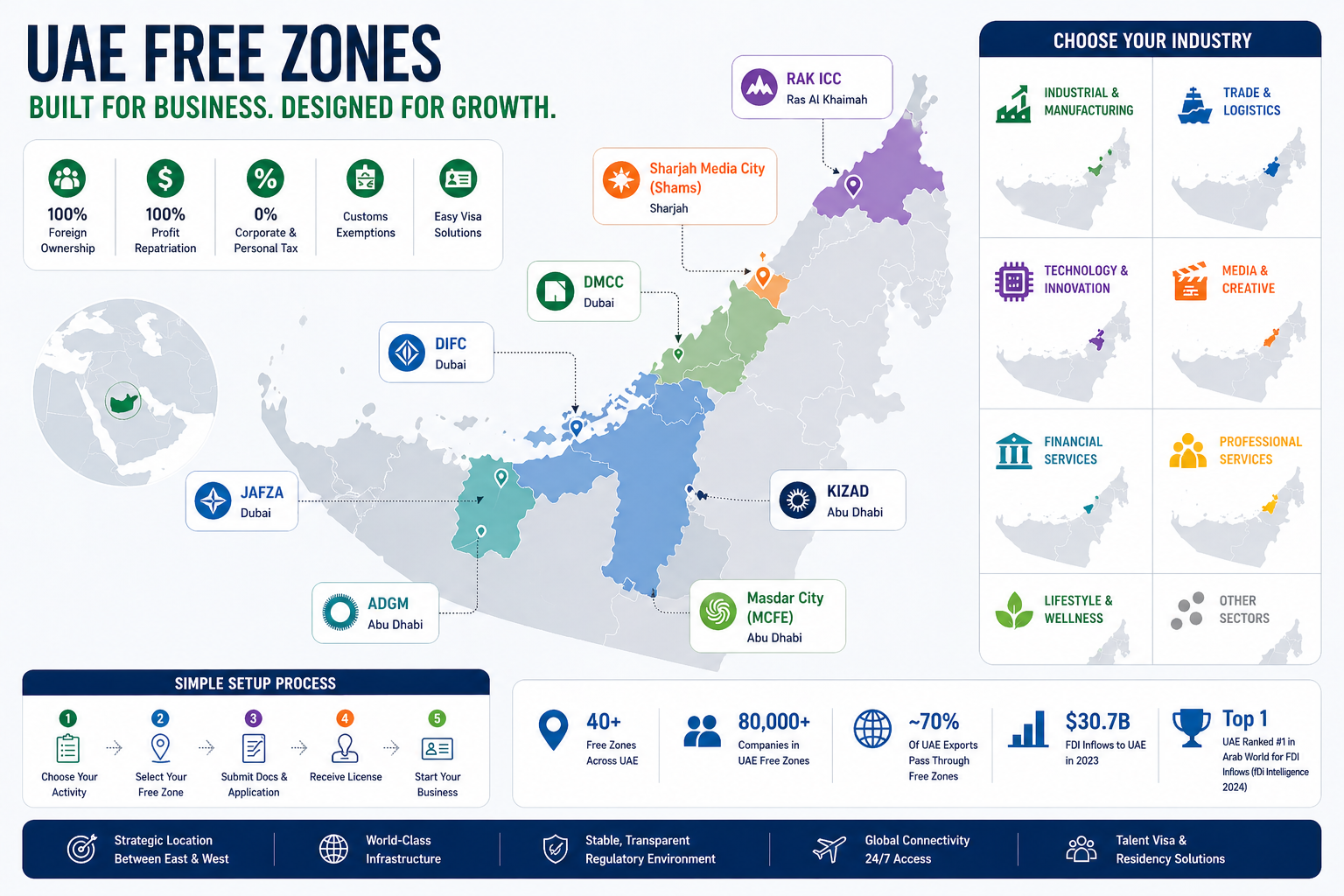
Choosing the right free zone in the United Arab Emirates (UAE) is a critical decision that directly impacts how a business operates, scales, and accesses markets. With over 40–45 free zones across the country, each governed by its own authority and regulatory framework, the selection process requires a structured evaluation rather than a cost-driven comparison.
Free zones differ in licensing scope, infrastructure, regulatory requirements, and sector focus. As a result, the choice should be based on how well a free zone supports the company’s operational model and long-term objectives.
See also: UAE Dubai South Free Zone Rolls Out New Incentives: What Investors Need to Know
Understanding free zones in the UAE
Free zones are designated economic areas operating under independent regulatory authorities. They are designed to attract foreign investment by offering simplified business setup, full foreign ownership, and tax advantages.
Beyond these incentives, free zones function as structured business environments aligned with specific industries. Each zone defines permitted activities, licensing requirements, and operational conditions, meaning that not all zones are suitable for every business type.
For most companies, free zones serve as platforms for international trade, regional headquarters, or specialized sector operations rather than purely domestic market entry.
Location and accessibility
Location is one of the most practical considerations when selecting a free zone, particularly for businesses dependent on logistics and supply chain efficiency.
Free zones located near major ports and airports provide clear advantages for trading and manufacturing companies. For example, zones integrated with maritime or air cargo infrastructure reduce transport costs and lead times.
Accessibility also affects workforce mobility, client access, and connectivity with other emirates. Businesses operating regionally may benefit from centrally located zones, while export-oriented companies typically prioritize proximity to logistics hubs.
Industry specialization
Each free zone is designed to support specific industries, and this specialization plays a central role in determining suitability.
Technology companies tend to cluster in dedicated innovation hubs, while media, healthcare, and financial services operate in zones with tailored infrastructure and regulatory oversight. Logistics and manufacturing companies, on the other hand, benefit from zones with warehousing and industrial capabilities.
Industry alignment ensures that licensing processes, compliance requirements, and operational support are suited to the business activity.
Free zones that lack sector familiarity can create bottlenecks in approvals, limit permitted activities, or complicate expansion.
Legal and regulatory framework
Every free zone operates under its own regulatory authority, which defines licensing, compliance, and reporting requirements.
Understanding this framework is essential, particularly for regulated industries such as finance, healthcare, or education. These sectors require environments with established oversight and clear regulatory pathways. Licensing categories also vary across zones.
Some allow multiple activities under a single license, while others impose stricter limitations. Failure to align business activities with licensing frameworks can lead to delays or the need for restructuring.
Regulatory clarity is particularly important for banking, taxation, and cross-border operations, where inconsistencies can affect operational continuity.
Cost considerations
Cost remains an important factor, but it should be assessed holistically rather than based solely on initial setup fees.
Typical cost components include:
- License and registration fees;
- Office or warehouse rental;
- Visa quotas and employee costs; and
- Ongoing compliance and renewal fees.
Entry-level setups can range from approximately AED 10,000 (US$2,722.46) to AED 20,000 (US$5,444.92), while more complex or infrastructure-heavy operations may exceed AED 30,000–50,000. (US$8,167.38 to 13,612.30)
Lower-cost free zones may be suitable for service-based businesses or startups, but operational requirements (such as infrastructure or regulatory support) often justify higher costs in specialized zones.
Infrastructure and facilities
Infrastructure is a defining factor in free zone selection, particularly for companies requiring physical operations.
Free zones offer a range of facilities, including:
- Virtual offices and co-working spaces;
- Serviced offices; and
- Warehouses and industrial units.
The availability and quality of these facilities directly affect operational efficiency. For example, logistics companies require access to storage and transport infrastructure, while digital businesses prioritize connectivity and office flexibility.
Technology infrastructure, including high-speed connectivity and reliable utilities, is also critical for seamless operations.
Market access and operational scope
Free zone companies are generally structured for international operations or activity within the zone itself. Direct access to the UAE mainland is typically restricted unless additional licensing or local partnerships are established.
This makes free zones particularly suitable for:
- Export-oriented businesses;
- E-commerce and digital services; and
- Regional headquarters managing multiple markets.
However, companies planning to serve the UAE domestic market directly may need to consider hybrid structures or mainland expansion at a later stage.
Visa and workforce considerations
Free zones provide integrated visa and immigration services, which are essential for staffing and operational planning.
Visa quotas are often linked to office size or license type. Smaller setups may allow limited visas, while larger facilities enable workforce expansion.
Some zones also offer additional support, including recruitment services and family sponsorship options, which can influence long-term workforce stability.
Ecosystem and networking potential
Free zones function as business ecosystems, not just regulatory jurisdictions.
Established zones provide access to:
- Supplier networks;
- Industry peers; and
- Professional service providers.
This ecosystem effect can accelerate market entry and support business development. Companies operating within strong clusters often benefit from collaboration opportunities and shared infrastructure.
Conclusion
Selecting the right free zone in the UAE requires a structured assessment of operational needs, regulatory requirements, and long-term strategy.
Key factors include:
- Alignment with business model and industry;
- Location and connectivity;
- Regulatory framework and licensing scope;
- Cost structure and infrastructure; and
- Market access and scalability.
The UAE’s free zone ecosystem offers significant advantages, but these benefits are only realized when the chosen jurisdiction supports how the business operates and grows.
A well-aligned free zone structure enables efficient operations, reduces friction, and provides a strong foundation for regional expansion.
About Us
Middle East Briefing is one of five regional publications under the Asia Briefing brand. It is supported by Dezan Shira & Associates, a pan-Asia, multi-disciplinary professional services firm that assists foreign investors throughout Asia, including through offices in Dubai (UAE). Dezan Shira & Associates also maintains offices or has alliance partners assisting foreign investors in China (including the Hong Kong SAR), Indonesia, Singapore, Malaysia, Mongolia, Japan, South Korea, Nepal, The Philippines, Sri Lanka, Thailand, Italy, Germany, Bangladesh, Australia, United States, and United Kingdom and Ireland.
For a complimentary subscription to Middle East Briefing’s content products, please click here. For support with establishing a business in the Middle East or for assistance in analyzing and entering markets elsewhere in Asia, please contact us at dubai@dezshira.com or visit us at www.dezshira.com.