Other Briefings
Qatar Foreign Company Boom 2026: Choosing the Right Market Entry Structure
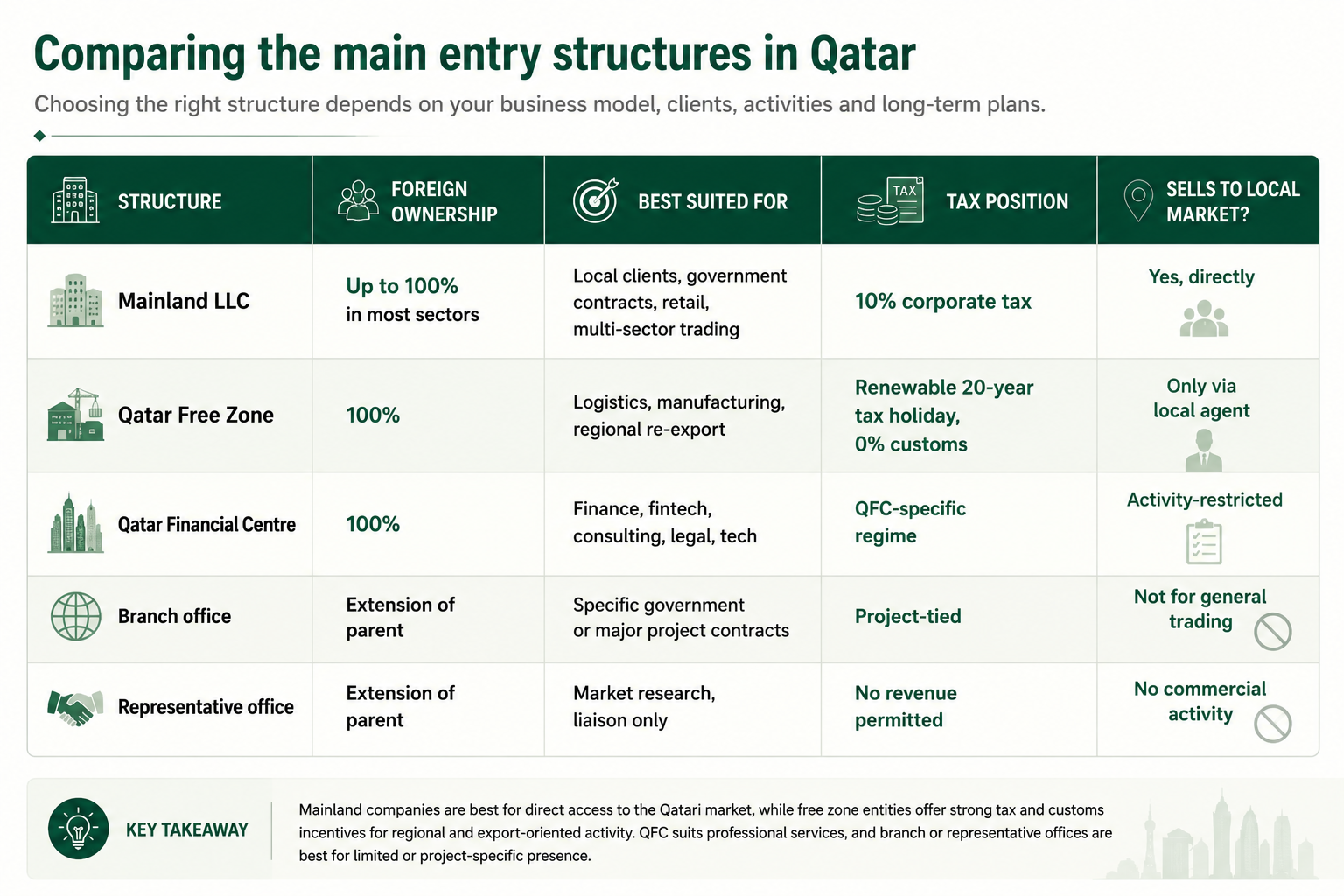
Qatar market entry structure decisions shape foreign investors’ tax exposure, ownership rights, market access, and operational flexibility from day one. The choice between a mainland LLC, Qatar Free Zone, Qatar Financial Centre, branch office, or representative office determines whether the company can sell to local clients, access tax holidays, or operate under common law principles. Success depends on aligning the legal structure with the commercial model before incorporation, rather than restructuring after the fact.

Foreign company registrations in Qatar rose sharply in 2025. Reportedly, more than 14,500 non-Qatari entities registered in the country over the year, a roughly six-fold increase on 2024. The figure reflects a broader effort to position Qatar as a competitive Gulf business destination, supported by foreign ownership reforms, expanded free zone incentives, digitalized government services.
Moreover, the diversification agenda set out in the Third National Development Strategy 2024–2030 is matched by a genuinely diversified economic case: National Planning Council data show non-hydrocarbon sectors generating 64 percent of GDP and growing 5.3 percent in Q1 2025.
For foreign investors, however, the commercial opportunity is only the starting point. The more concrete question is which entry structure best matches the company’s revenue model, client base, sector, and tax position. This choice reduces to three intersecting variables: where revenue will be earned, what kind of counterparty the company will contract with, and whether the activity is regulated.
Companies focused on the domestic market generally gravitate to mainland LLCs, while those operating regionally or internationally tend toward the Qatar Free Zones or the Qatar Financial Centre (QFC); branch and representative offices remain narrow-purpose vehicles, useful in specific scenarios but rarely as a primary entry route. This article compares the available structures, the trade-offs each carries, and the practical considerations foreign investors should weigh before incorporation.
Ready to plan your Qatar market entry? Our regional advisory team helps foreign investors structure entry, secure the right licensing, and build compliant operations across the Gulf. Speak to our specialists.
Mainland LLC: Broad access to the local market
The mainland LLC, referred to locally as an LLC or WLL, is the structure most commonly adopted by foreign investors pursuing long-term commercial operations in Qatar. Currently, most foreign investors entering Qatar choose either a mainland LLC for long-term commercial activity or a branch office for project-specific work, and the wrong structure can require months of rework.
The mainland route tends to suit companies targeting:
- Local clients;
- Government-linked opportunities;
- Retail;
- Construction;
- Trading; and
- Multi-sector activity.
Companies fall under the Qatar Ministry of Commerce and Industry, and although Law No. 1 of 2019 permits 100 percent foreign ownership across most sectors, certain regulated activities (banking, insurance, and selected professional services among them) still carry local participation requirements that warrant verification at the planning stage.
Notably, a standard mainland LLC typically requires minimum share capital of QAR 200,000 (US$54,851), although this varies by activity. For investors whose principal objective is selling into the domestic market, the mainland route is generally more appropriate than a free zone entity, even where the latter offers more attractive tax incentives.
See also: Where to Set Up in Qatar: Special Economic Zones and Industrial Areas
Qatar Free Zones: Logistics, manufacturing, and export-oriented operations
A Qatar Free Zone entity, by contrast, tends to suit companies prioritising regional trade, logistics, manufacturing, industrial technology, and export-oriented activity. Qatar Free Zone LLCs offer 100 percent foreign ownership, operational autonomy, renewable 20-year tax holidays, and zero customs duties on imports.
Moreover, they are positioned at Ras Bufontas and Umm Al Houl, the country’s principal free zones, co-located with Hamad International Airport and Hamad Port respectively. Both zones as offering dedicated industrial and logistics infrastructure for traditional SMEs in manufacturing, logistics, and food and beverage.
Companies intending to sell into the mainland from a free zone, however, should plan for the additional layer. Mainland sales by free zone entities typically require a local agent, which can offset some of the operational simplicity that motivates the free zone choice in the first place.
Qatar Financial Centre: Services, finance, and technology
The QFC is a specialised jurisdiction used principally by professional services, finance, fintech, consulting, legal, and technology firms. QFC registration typically takes four to eight weeks where documentation is complete, and the centre operates under a common law framework, a significant advantage for firms accustomed to UK or US legal norms.
Activity restrictions, however, warrant careful review where the business intends to engage in physical trading, retail, or manufacturing activities better suited to the mainland or free zones; it is noteworthy to flag this as a scenario where companies often need parallel or alternative structures.
Branch and representative offices
A branch office allows a foreign company to operate in Qatar without incorporating a separate local entity, although the route is generally tied to specific government contracts or major projects rather than to broad commercial trading.
The parent company remains fully liable for branch obligations. A representative office is more constrained still: it can support market research, promotion, and liaison activity but cannot generate revenue, sign contracts, or import goods for sale.
Common mistakes foreign investors in Qatar should avoid
By a meaningful margin, the most consequential error is selecting a Qatar market entry structure based on speed or fee quotation rather than commercial fit. The implications tend to surface later, when the company attempts to scale or shift its activities. Many SMEs underestimate the importance of obtaining the correct commercial activity codes at registration, which can force costly amendments later.
Banking is another frequent bottleneck: Qatari banks apply rigorous anti-money laundering compliance standards, and corporate account opening for foreign-owned entities can take several weeks, requiring careful documentation preparation.
Key takeaways
- Match the structure to the revenue model, not the registration timeline: Mainland LLCs suit companies selling into the domestic Qatari market; free zones suit regional trade, logistics, and export-oriented activity; the QFC suits professional services and regulated finance.
- Verify foreign ownership eligibility by activity, not by sector: Although Law No. 1 of 2019 permits 100 percent foreign ownership across most sectors, regulated activities (banking, insurance, and selected professional services) still carry local participation requirements that require sector-specific confirmation.
- Plan around banking timelines from day one: Corporate account opening for foreign-owned entities can take several weeks; documentation work should run in parallel with company registration, not after it.
- Get the activity codes right at registration: Narrowly defined or incorrect activity codes are one of the most common sources of post-incorporation amendments and delays.
- Build the entry plan around scale, not speed: Companies that treat structure selection as a substantive strategic question, rather than a procedural step, tend to be the ones whose Qatar operations scale without restructuring.
About Us
Middle East Briefing is one of five regional publications under the Asia Briefing brand. It is supported by Dezan Shira & Associates, a pan-Asia, multi-disciplinary professional services firm that assists foreign investors throughout Asia, including through offices in Dubai (UAE). Dezan Shira & Associates also maintains offices or has alliance partners assisting foreign investors in China (including the Hong Kong SAR), Indonesia, Singapore, Malaysia, Mongolia, Japan, South Korea, Nepal, The Philippines, Sri Lanka, Thailand, Italy, Germany, Bangladesh, Australia, United States, and United Kingdom and Ireland.
For a complimentary subscription to Middle East Briefing’s content products, please click here. For support with establishing a business in the Middle East or for assistance in analyzing and entering markets elsewhere in Asia, please contact us at dubai@dezshira.com or visit us at www.dezshira.com.