Other Briefings
September 30, 2026 Corporate Tax Deadline: A Checklist
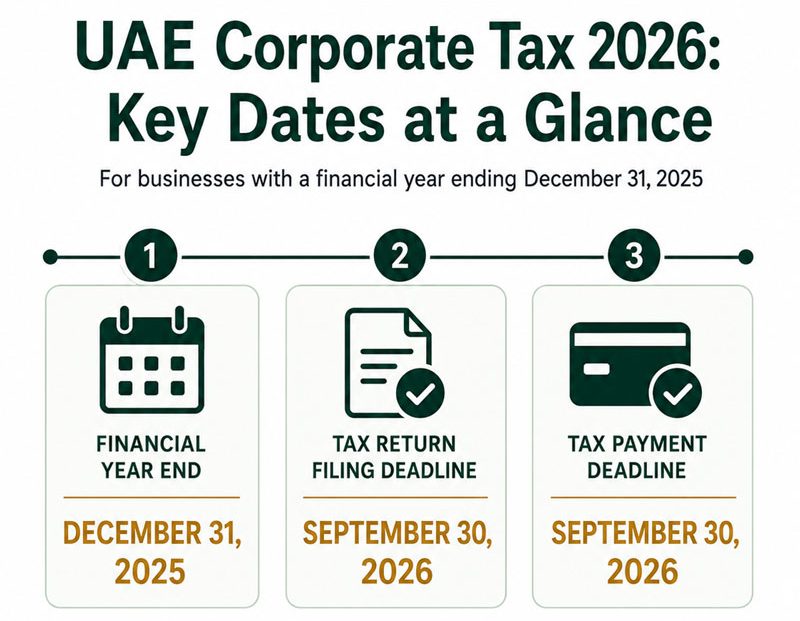
For businesses with a financial year ending December 31, 2025, the UAE Corporate Tax return and payment deadline is September 30, 2026. This checklist walks through the key steps, documents, and deadlines to help companies file on time and avoid penalties.
This checklist applies to businesses whose financial year ends on December 31, 2025. For these companies, the Corporate Tax return filing and payment deadline falls on September 30, 2026.
The UAE introduced Corporate Tax in 2023, and by 2026 most businesses have entered a routine compliance cycle. Meeting the deadline consistently is critical not only to avoid penalties but also to maintain a clean compliance record with the Federal Tax Authority. The purpose of this checklist is to help finance teams prepare early, avoid common errors, and meet the deadline without incurring penalties or interest charges.
Free Webinar — UAE Corporate Tax Filing: What Businesses Should Do Before the Deadline
Thursday, June 25, 2026 | 11:00 AM (GST)
To help businesses prepare ahead of the September deadline, Virtuzone is hosting a free webinar for UAE entrepreneurs at 11 AM on 25 June. It will be led by the Managing Director of Taxready (a Virtuzone company), a registered tax agent with Big 4 experience.
Pre-filing checklist
Determine whether the business must file a return
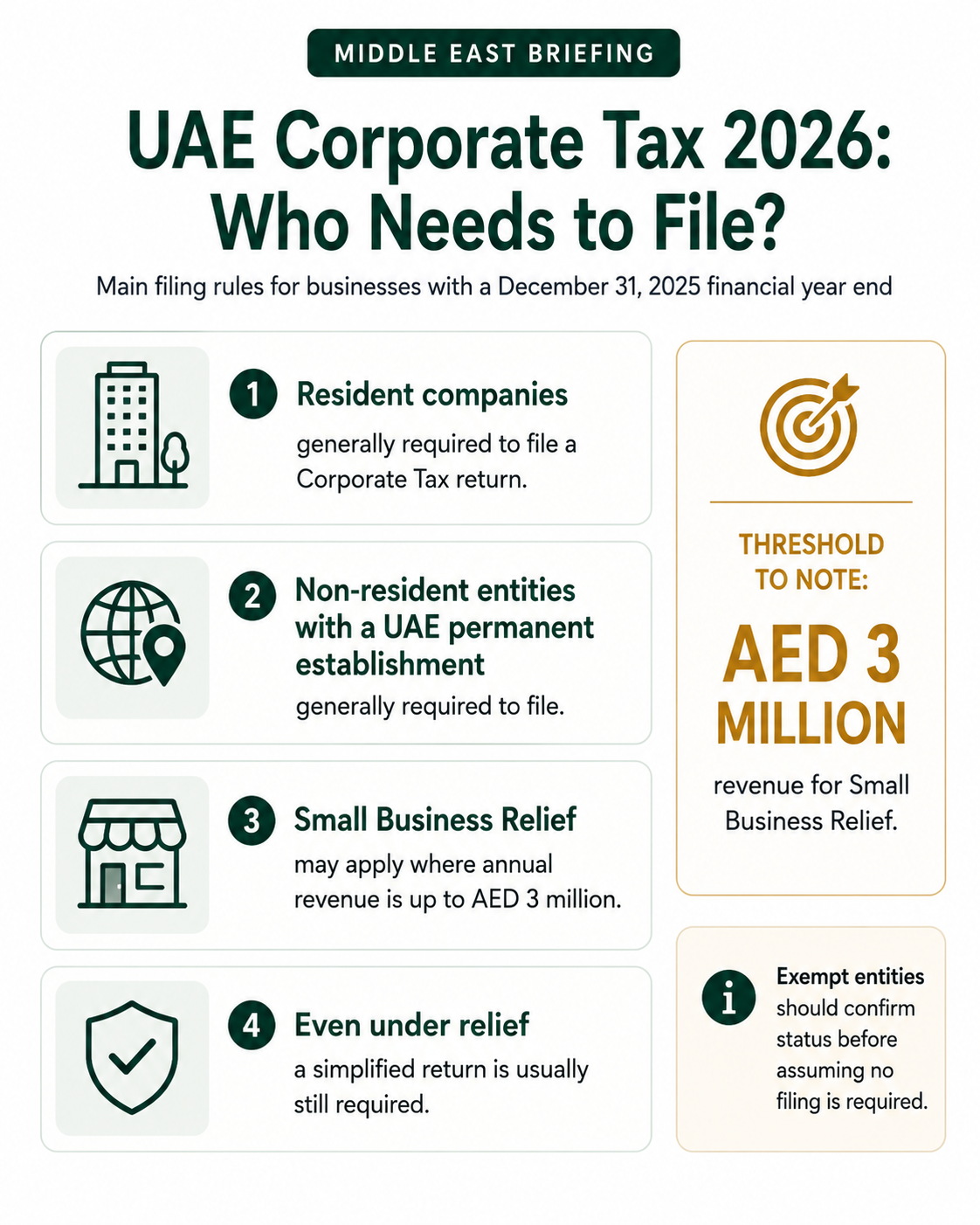
Every taxable person, including resident companies and non-resident entities with a permanent establishment in the UAE, is required to file a Corporate Tax return unless specifically exempt. Businesses with annual revenue below AED 3 million (US$816,900) may qualify for Small Business Relief, which reduces record‑keeping and documentation obligations.
However, even under this relief, a simplified return must still be filed in most cases. It is important to confirm eligibility before assuming that filing is not required. The Federal Tax Authority provides clear guidance on which entities qualify as taxable persons, and reviewing that guidance early is advisable.
Prepare financial statements

Audited financial statements are not mandatory for all businesses, but certain categories, such as large enterprises or free zone entities claiming relief, must obtain them. Even when not required, having reviewed or audited financial statements significantly reduces the risk of calculation errors and supports a smoother audit process.
Moreover, well‑prepared financial statements help demonstrate the accuracy of the taxable income calculation, should the Federal Tax Authority request supporting information later. Financial statements should be finalized and reviewed at least one month before the filing deadline.
Calculate taxable income
Taxable income is calculated starting from accounting net profit. The following common adjustments apply:
- Non-deductible expenses, such as dividends, fines, penalties, and 50 percent of entertainment expenses, must be added back.
- Exempt income, such as qualifying intra-group dividends under the participation exemption, may be deducted.
- The first AED 375,000 (US$102,113) of taxable profit is taxed at 0 percent, and any amount above that threshold is taxed at 9 percent.
It is important to distinguish between accounting profit (prepared under financial reporting standards) and taxable profit (adjusted for tax purposes). These two figures often differ, and the adjustments must be properly documented. Finance teams should maintain a clear working paper that tracks these adjustments throughout the year, rather than attempting to reconstruct them at the end of year.
Identify applicable reliefs and exemptions
Several reliefs may apply depending on the business:
- Small Business Relief: Available for businesses with revenue up to AED 3 million (US$816,900), simplifying record-keeping and reducing documentation requirements.
- Free Zone Person Relief: Allows qualifying free zone entities to apply a 0% rate on qualifying income, subject to meeting substance requirements and not engaging in excluded activities.
- Participation Exemption: Exempts dividends and capital gains from qualifying shareholdings.
- Transfer pricing exemption: Certain related party transactions may be exempt from full transfer pricing documentation requirements.
Eligibility for each relief must be checked before filing, as the return requires formal declarations. Supporting documentation for the claimed relief should be retained in case of future review by the Federal Tax Authority.
Gather supporting documents
Before starting the return, the following documents should be assembled:
- Tax Registration Number (TRN);
- Audited or reviewed financial statements (if required);
- Trial balance and general ledger extracts;
- Fixed asset register with depreciation calculations;
- Loan agreements, invoices, and contracts for related party transactions;
- Transfer pricing documentation (where applicable);
Organizing these documents in advance helps streamline the filing process and ensures readiness for any subsequent review by the Federal Tax Authority. Digital storage with clear naming conventions is recommended for efficient retrieval.
Filing and payment steps
- Log into the EmaraTax portal using the company’s credentials;
- Complete the Corporate Tax return form by entering the required financial information, taxable income calculation, and any claimed reliefs;
- Upload supporting documents only if requested by the Federal Tax Authority (not all returns require attachments);
- Pay the tax due before midnight on September 30, 2026, using the electronic payment methods available within EmaraTax;
- Save proof of filing and payment, including the acknowledgment receipt and payment confirmation, for future reference;
It is advisable to complete the filing at least a few days before the deadline to avoid potential system slowdowns or last-minute technical issues on the final day.
Too often, companies can’t properly justify business expenses, owner salaries, or key transactions — and many wrongly assume qualifying free zone status is automatic, when it requires economic substance and supporting documentation. Get this wrong, and you risk losing 0% corporate tax for the next four years. Once the deadline is near, it’s usually too late to fix salary payments, gather documents, or structure your position correctly. Some businesses miss key deadlines and pay more in penalties than their tax would ever have been. My advice is simple: don’t wait. Starting your tax work early — well before the September deadline — gives you the time to review, fix, and prepare everything properly. – Maryia Vinahradava, Director of Corporate Services, Virtuzone
Penalties for late filing or non-compliance
Late filing attracts fixed monthly penalties. Under the current rules, the penalty is AED 500 (US$136) per month for the first 12 months of delay, increasing to AED 1,000 (US$272) per month thereafter. Late payment of tax triggers annual interest of 14 percent on the unpaid amount.
Additional administrative penalties may apply for incorrect returns, failure to keep required records, or failure to provide information when requested by the Federal Tax Authority. Repeated non-compliance may also affect the company’s risk rating and increase the likelihood of future audits.
Practical tips
- Start preparation at least three months before the deadline to avoid a last-minute rush;
- Use accounting software that tracks taxable adjustments throughout the year, making year-end calculations easier and more reliable;
- First-time filers or groups with complex structures should consider engaging a tax agent;
- Keep all records for the legally required period of seven years from the end of the relevant tax period; and
- Set up internal compliance reminders to track key deadlines, and ensure that the company’s contact details and authorized signatories are up-to-date with the EmaraTax portal to avoid administrative delays.
Takeaways
Filing the Corporate Tax return on or before September 30, 2026 is essential to avoid penalties and maintain a good compliance standing with the Federal Tax Authority. The checklist above covers the essential steps, but each business should review its own circumstances carefully. Building a structured annual compliance process around the Corporate Tax cycle can reduce stress, improve accuracy, and free up resources for core business activities.

When in doubt, consulting a tax professional is strongly recommended.
How Dezan Shira & Associates can help:
Our tax advisors can support businesses in assessing their obligations, understanding applicable compliance requirements, and developing practical strategies to manage tax exposure across relevant jurisdictions. For tailored guidance, please contact our team.
About Us
Middle East Briefing is one of five regional publications under the Asia Briefing brand. It is supported by Dezan Shira & Associates, a pan-Asia, multi-disciplinary professional services firm that assists foreign investors throughout Asia, including through offices in Dubai (UAE). Dezan Shira & Associates also maintains offices or has alliance partners assisting foreign investors in China (including the Hong Kong SAR), Indonesia, Singapore, Malaysia, Mongolia, Japan, South Korea, Nepal, The Philippines, Sri Lanka, Thailand, Italy, Germany, Bangladesh, Australia, United States, and United Kingdom and Ireland.
For a complimentary subscription to Middle East Briefing’s content products, please click here. For support with establishing a business in the Middle East or for assistance in analyzing and entering markets elsewhere in Asia, please contact us at dubai@dezshira.com or visit us at www.dezshira.com.
- Previous Article Setting Up a Business in Dubai: A 2026 Guide
- Next Article France-UAE Business Ties: Why French Companies Are Expanding in the UAE