Other Briefings
UAE Virtual Assets 2026: New Framework and Key Developments
The UAE 2026 virtual assets updates create new opportunities for exchanges, fintechs, custodians, token issuers, and institutional investors, particularly in derivatives, token activity, and digital asset infrastructure.

The UAE’s virtual assets market is entering a more selective phase. Recent updates from the Capital Markets Authority (CMA), Dubai’s Virtual Assets Regulatory Authority (VARA), the Dubai Financial Services Authority (DFSA), and the Financial Services Regulatory Authority (FSRA) are widening the scope for regulated digital asset activity, while raising the threshold for market entry, product approval, and ongoing compliance.
For exchanges, custodians, brokers, token issuers, fintech groups, asset managers, and institutional investors, the commercial impact is direct. The UAE continues to support virtual asset growth, but firms now need stronger licensing strategies, better capital planning, more mature compliance systems, and clearer jurisdictional choices.
Businesses planning to enter or expand in the UAE should assess whether their current structure remains fit for purpose under the new regulatory environment.
See also: Dubai’s VARA Licensing Framework for Virtual Asset Businesses: A Practical Roadmap
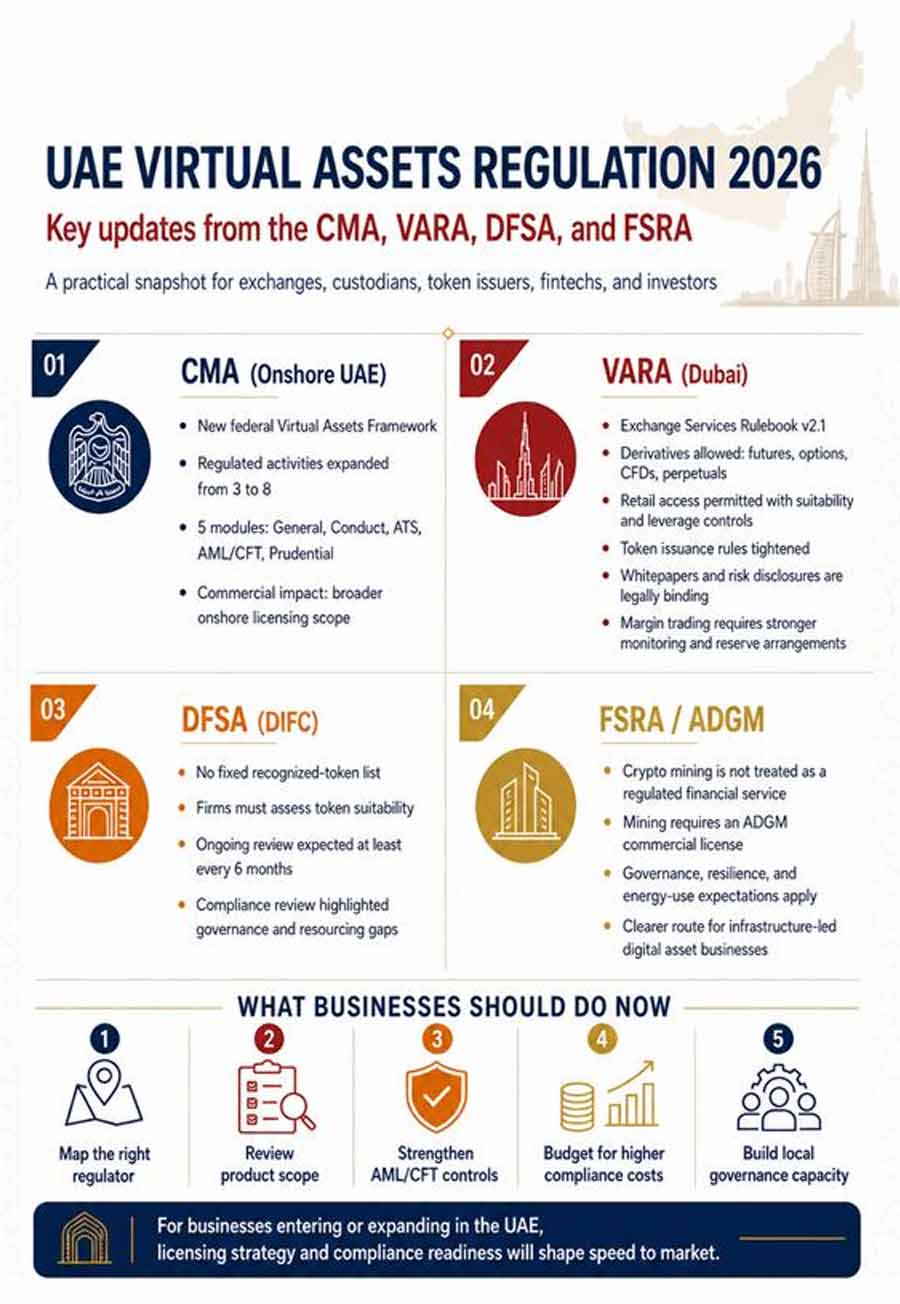
Key business implications
The latest regulatory changes create five immediate priorities for market participants.
- Licensing strategy needs to be reassessed: The CMA’s new federal framework expands regulated virtual asset activities from three to eight categories and introduces a more detailed onshore licensing perimeter. Firms offering multiple services may need additional approvals or a revised group structure.
- Product opportunities are expanding: VARA’s updated Exchange Services Rulebook permits exchange-traded virtual asset derivatives, including futures, options, contracts for difference, and perpetuals, under a permanent regulatory framework. This creates new opportunities for licensed platforms, brokers, and liquidity providers.
- Token activity carries higher responsibility: VARA has strengthened disclosure expectations for virtual asset issuances, while the DFSA has moved from a recognized-token model to a firm-led suitability assessment model. Firms will need stronger token review, approval, and monitoring procedures.
- Compliance resourcing will affect speed to market: Regulators are focusing on AML/CFT, sanctions screening, client suitability, governance, record-keeping, and operational resilience. Firms with light compliance structures may face licensing delays or closer supervisory scrutiny.
- Jurisdictional choice is now a commercial decision: Onshore UAE, Dubai, DIFC, and ADGM each offer different regulatory routes. The right choice will depend on the firm’s products, client base, ownership model, capital position, and regional growth plans.
CMA: New federal framework for onshore virtual asset activity
In April 2026, the CMA issued a new Virtual Assets Framework for the UAE. The framework expands regulated virtual asset activities from three to eight categories and introduces five core modules covering general requirements, conduct of business, alternative trading systems, AML/CFT, and prudential standards.
The framework is important for firms seeking onshore UAE access. It gives greater structure to federal regulation and creates a clearer route for businesses operating outside the financial free zones.
Commercially, the main impact is licensing scope. Firms involved in exchange services, custody, brokerage, advisory, portfolio management, arranging transactions, or trading infrastructure should review whether their current or planned activities fall within the new CMA categories.
Businesses should also assess whether the new framework affects capital requirements, local governance, compliance staffing, outsourcing, and operational controls.
Action point: Firms with onshore UAE operations, or plans to serve UAE clients outside DIFC and ADGM, should conduct a licensing gap analysis against the CMA framework.
VARA: New route for derivatives and margin products
VARA’s Exchange Services Rulebook Version 2.1 (hereinafter, the “rulebook”), effective March 31, 2026, introduces a formal regime for exchange-traded virtual asset derivatives. The rulebook covers products such as futures, options, contracts for difference, and perpetuals.
This is one of the most commercially significant updates in the UAE virtual assets market. It gives licensed VASPs a regulated path to move beyond spot trading and develop higher-value products for retail and institutional clients.
The opportunity is subject to strict controls. VASPs need separate approval to offer exchange-traded derivatives. Retail access is subject to suitability, leverage, disclosure, and risk management requirements. VARA also prohibits proprietary trading in these products, including through affiliates, to reduce conflicts of interest.
Margin trading is also subject to tighter controls, including real-time monitoring, early warning systems, structured liquidation protocols, and insurance or reserve fund arrangements.
Action point: Platforms considering derivatives or margin products should test their product economics against VARA’s approval, leverage, risk management, and reserve requirements before launch.
VARA: Token issuers and distributors face higher disclosure risk
VARA has clarified its approach to virtual asset issuances. Certain Category 2 issuances may proceed without a standalone issuer license where a licensed distributor is involved. Category 1 licenses are required for fiat-referenced and asset-referenced tokens.
The business risk sits in disclosure. Whitepapers and risk disclosures are now treated as legally binding documents. Issuers, distributors, and platforms should treat token materials as regulated offering documents, with proper legal, technical, and commercial verification before publication.
This affects launch timelines and liability exposure. Token projects should build in more time for documentation, risk review, and internal approvals.
Action point: Token issuers should review whitepaper controls, sign-off procedures, distributor arrangements, and liability allocation before entering the UAE market.
VARA: AML/CFT remains a licensing priority
VARA’s AML/CFT circular reinforces customer due diligence, enhanced due diligence, sanctions screening, suspicious activity reporting, and record-keeping obligations.
Customer due diligence is required at onboarding and for transactions above AED 3,500. Higher-risk cases require enhanced due diligence.
For VASPs, this is a practical operating issue. Regulators will expect working systems, trained staff, clear escalation channels, blockchain analytics, wallet screening, transaction monitoring, and senior management reporting.
Action point: Firms should review whether their AML/CFT systems are operationally ready before applying for approval or expanding regulated activities.
DFSA: Token flexibility shifts responsibility to firms
The DFSA has changed its crypto token framework in the DIFC. Firms are now expected to determine whether a crypto token is suitable based on their own assessment, replacing the previous recognized-token approach.
This gives firms more flexibility to develop products and support a wider range of tokens. It also places more responsibility on boards, senior management, and compliance teams.
Suitability assessments should cover legal, technical, market, liquidity, custody, operational, and financial crime risks. Firms must monitor tokens on an ongoing basis and reassess suitability at least every six months.
Action point: DIFC firms should establish a documented token approval process, including review committees, risk scoring, periodic reassessment, and escalation procedures for higher-risk assets.
DFSA: Compliance arrangements under closer review
The DFSA’s April 2026 review of compliance arrangements identified weaknesses in governance, oversight, monitoring, and compliance resourcing.
This matters for firms seeking authorization or expansion in the DIFC. Compliance capacity can directly affect approval timelines, supervisory engagement, and business scalability.
Firms relying on group-level or outsourced compliance support should ensure that local accountability is clear and that the UAE compliance function has sufficient seniority, resources, and access to management information.
Action point: Firms should review compliance staffing, reporting lines, monitoring plans, and board oversight before submitting new applications or expanding activity permissions.
FSRA and ADGM: Clarity for mining and infrastructure models
ADGM has provided further clarity on crypto mining activities. Crypto mining is not treated as a regulated financial service requiring FSRA authorization. It is treated as a licensable commercial activity under ADGM’s Registration Authority.
Entities conducting crypto mining activities must obtain the appropriate commercial license and comply with applicable governance, operational resilience, corporate transparency, and energy-use expectations.
This creates a clearer route for mining and infrastructure operators seeking a regulated base in the UAE. Firms combining mining with custody, staking, brokerage, or other virtual asset services should review whether additional FSRA permissions are required.
Action point: Mining and infrastructure businesses should separate commercial licensing analysis from financial services licensing analysis when structuring ADGM operations.
What businesses should do now
Virtual asset firms should take a practical approach to the latest UAE regulatory changes.
- Map the regulatory perimeter: Identify which activities fall under the CMA, VARA, DFSA, or FSRA regimes.
- Review the UAE entity structure: Assess whether the current setup supports licensing, client servicing, custody, booking, and governance requirements.
- Stress-test product plans: Derivatives, margin trading, token issuance, and token listings now require stronger controls and longer preparation timelines.
- Upgrade compliance capacity: AML/CFT, sanctions, suitability, monitoring, and reporting functions should be resourced before expansion.
- Build regulatory costs into the business case: Licensing, capital, insurance, technology controls, local management, compliance systems, and audits should be reflected in UAE market-entry budgets.
Outlook
The UAE remains one of the most active virtual asset markets in the Middle East. The direction of regulation is supportive of growth, but more demanding on execution.
Firms with strong governance, sufficient capital, clear licensing strategies, and credible compliance infrastructure will be better placed to benefit from the next phase of market development. Firms with light operating models or under-resourced compliance functions may face slower approvals, higher remediation costs, or limits on product expansion.
For market participants, the immediate priority is to align commercial strategy with regulatory structure. In the UAE, the choice of jurisdiction, license type, product scope, and compliance model will directly affect speed to market and long-term scalability.
About Us
Middle East Briefing is one of five regional publications under the Asia Briefing brand. It is supported by Dezan Shira & Associates, a pan-Asia, multi-disciplinary professional services firm that assists foreign investors throughout Asia, including through offices in Dubai (UAE). Dezan Shira & Associates also maintains offices or has alliance partners assisting foreign investors in China (including the Hong Kong SAR), Indonesia, Singapore, Malaysia, Mongolia, Japan, South Korea, Nepal, The Philippines, Sri Lanka, Thailand, Italy, Germany, Bangladesh, Australia, United States, and United Kingdom and Ireland.
For a complimentary subscription to Middle East Briefing’s content products, please click here. For support with establishing a business in the Middle East or for assistance in analyzing and entering markets elsewhere in Asia, please contact us at dubai@dezshira.com or visit us at www.dezshira.com.