Other Briefings
How to Register for Corporate Tax in the UAE: Step-by-Step Guide
Corporate Tax registration in the UAE is a mandatory step for all taxable persons. This guide walks through the registration process on the EmaraTax platform, covering who needs to register, what documents are required, and how to complete each step.
Corporate Tax registration in the United Arab Emirates is a legal requirement under Federal Decree-Law No. 47 of 2022. All taxable persons, including resident companies and non-resident entities with a permanent establishment in the UAE, must register for Corporate Tax. Registration is the first step before filing a Corporate Tax return. Without registration, a company cannot meet its filing obligations, which can lead to penalties.

The Federal Tax Authority (FTA) has made the registration process available through the EmaraTax platform, a single digital portal for all tax-related services. The process is straightforward when the required information and documents are prepared in advance. This guide provides a step-by-step walkthrough of the Corporate Tax registration process, covering the preparation checklist, each registration step, common issues, and what to do after registration.
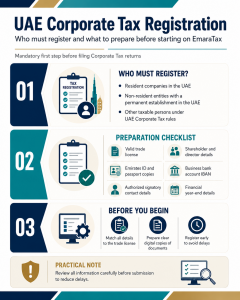
Before start the UAE Corporate Tax registration process: Preparation checklist
Before beginning the registration, the following information and documents should be gathered. Having these ready in advance makes the process faster and reduces the risk of errors.
- Tax Registration Number (TRN): The business must already be registered for VAT to have a TRN. If the company is not VAT-registered, it should complete VAT registration first.
- Business license: A valid trade license issued by the relevant authority in the UAE, such as the Department of Economy and Tourism (DET) in Dubai or the relevant free zone authority.
- Shareholder and director details: Names, nationalities, Emirates ID copies, and passport copies of shareholders and directors.
- Bank account information: The IBAN of the business bank account in the UAE.
- Contact details: An email address and phone number of the authorised signatory who will be responsible for the registration and future correspondence with the FTA.
Step-by-step registration process
Step 1 – Log in to the EmaraTax portal
Access the EmaraTax platform at eservices.tax.gov.ae. If the company is already registered for VAT, use the existing credentials to log in. For new users, an account must be created first. The account creation process requires basic business information and verification of the authorized person’s identity.
Step 2 – Navigate to Corporate Tax Registration
Once logged in, locate the Corporate Tax section on the dashboard. From there, select “Tax Registration” or “Corporate Tax” and choose the option to “Register for Corporate Tax”. The system will then proceed to the registration form.
Step 3 – Complete the registration form
The registration form requires the following information:
- Business details: the legal name, trade license number, and the issuing authority of the license.
- Authorized signatory: the full name, position, and contact details of the person authorized to act on behalf of the business.
- Financial year-end: the company’s accounting period end date, which determines the filing deadlines.
- Business activities: a declaration of the main business activities and relevant sectors.
Supporting documents must also be uploaded. These typically include a copy of the trade license, Emirates ID and passport copies of shareholders and directors, and any other documents requested by the system.
Step 4 – Review and submit
After completing the form and uploading the documents, all entered information should be carefully reviewed. Errors or inconsistencies can cause delays. Once confirmed, the application can be submitted. The system will generate a reference number for tracking purposes.
Step 5 – Await approval
The Federal Tax Authority will review the submitted application. Processing times can vary but typically range from a few days to a few weeks. The FTA may request additional information or clarification during this stage. Approval confirmation will be sent via email once the registration is complete.
Step 6 – Post-approval: access Corporate Tax services
Once registered, the company can access Corporate Tax filing and payment services through the EmaraTax dashboard. The company is now able to file Corporate Tax returns and fulfil its ongoing compliance obligations.
Common issues and how to avoid them
Some common issues can delay the registration process. Being aware of these helps avoid unnecessary delays.
- Incomplete documentation: Missing or incorrect documents are a frequent cause of delays. All required documents should be verified before submission and uploaded in the correct format as specified by the platform.
- Mismatched information: The details provided on the tax registration form must exactly match the information on the trade license. Any discrepancy, such as a misspelled name or an incorrect license number, can cause the application to be flagged for review.
- Incorrect financial year-end: The financial year-end date should match the company’s accounting period. An incorrect date will affect filing deadlines and may require a correction later.
- Authorized signatory not recognized: The person registering must have the correct authority in the EmaraTax system. If the authorized signatory has not been set up correctly, the system may reject the application.
After registration
After successful registration, the company can begin preparing and filing Corporate Tax returns. The registration confirmation should be kept for future reference. The company should also monitor the EmaraTax dashboard regularly for any additional requests or notifications from the Federal Tax Authority. Staying proactive ensures that no deadlines are missed and that the company remains in good standing with the FTA.
Conclusion
Registering for Corporate Tax in the UAE is a straightforward process when the required documents and information are prepared in advance. The EmaraTax platform provides a single digital channel for all tax-related services, making registration and compliance more efficient.
Early registration is advisable to avoid last-minute issues and potential penalties. Companies should ensure they complete the registration well before their first filing deadline.
How Dezan Shira & Associates can help
UAE Corporate Tax registration is a key step for meeting FTA compliance obligations. Dezan Shira & Associates can support businesses with assessing registration requirements, preparing documentation, reviewing EmaraTax submissions, and managing post-registration compliance.
To arrange a consultation, please contact our Middle East tax and compliance experts by emailing dubai@dezshira.com.
About Us
Middle East Briefing is one of five regional publications under the Asia Briefing brand. It is supported by Dezan Shira & Associates, a pan-Asia, multi-disciplinary professional services firm that assists foreign investors throughout Asia, including through offices in Dubai (UAE). Dezan Shira & Associates also maintains offices or has alliance partners assisting foreign investors in China (including the Hong Kong SAR), Indonesia, Singapore, Malaysia, Mongolia, Japan, South Korea, Nepal, The Philippines, Sri Lanka, Thailand, Italy, Germany, Bangladesh, Australia, United States, and United Kingdom and Ireland.
For a complimentary subscription to Middle East Briefing’s content products, please click here. For support with establishing a business in the Middle East or for assistance in analyzing and entering markets elsewhere in Asia, please contact us at dubai@dezshira.com or visit us at www.dezshira.com.