Other Briefings
UAE’s AED 6,000 Minimum Wage Rule for Emiratis: What Employers Must Do Before June 30, 2026
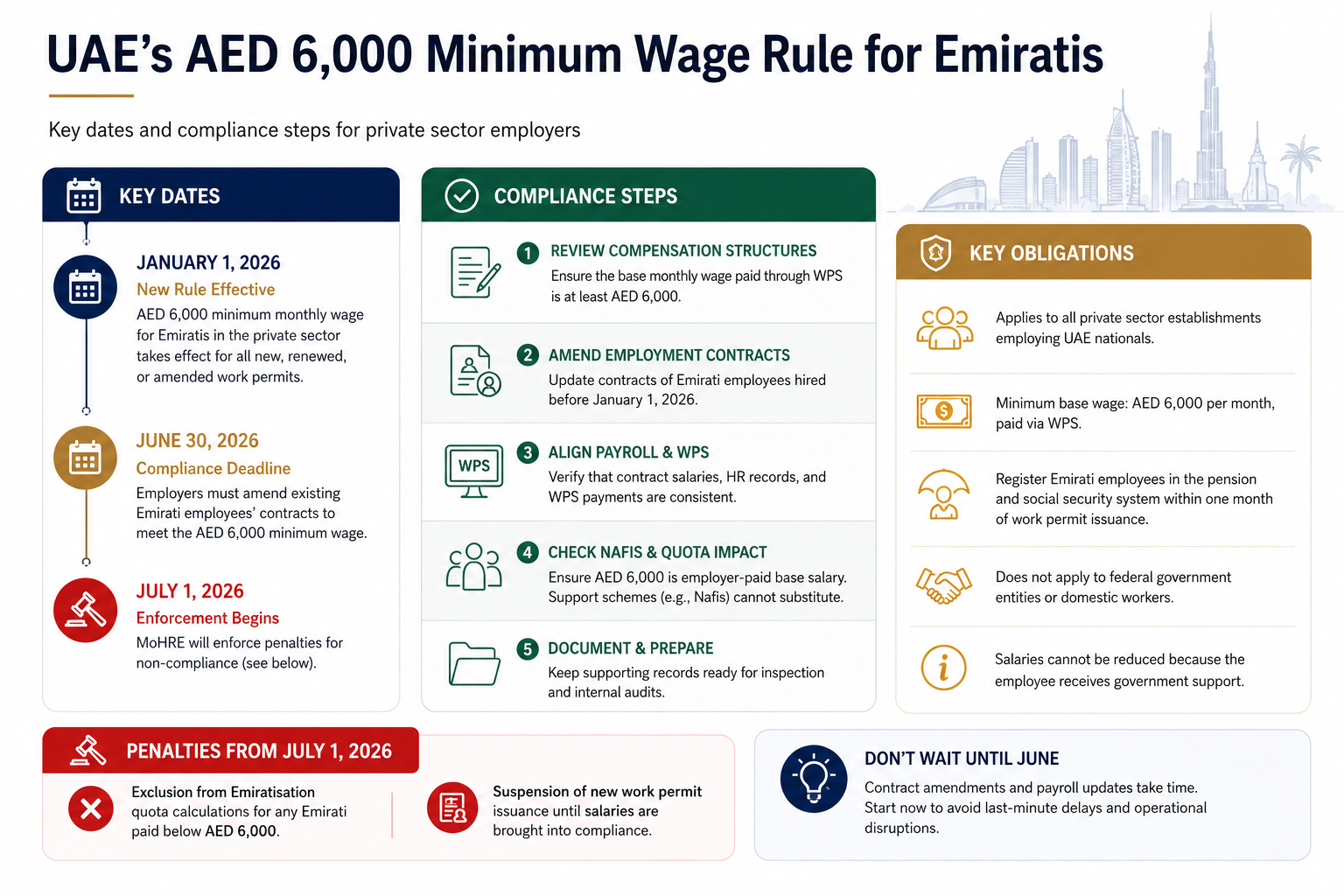
The UAE’s AED 6,000 minimum wage for Emiratis rul took effect on January 1, 2026, with employers given until June 30 to amend existing contracts. From July 1, 2026, MoHRE penalties include exclusion from Emiratisation quotas and suspension of new work permits.
UAE Ministry of Human Resources and Emiratization (MoHRE) has confirmed that the new AED 6,000 (US$1,633) minimum monthly wage for Emiratis employed in the private sector took effect on January 1, 2026, with employers given until June 30 to bring existing Emirati staff into compliance. Starting from July 1, 2026, MoHRE will begin enforcing penalties, including exclusion of underpaid Emirati employees from Emiratization quota calculations and suspension of new work permit issuance until salaries are corrected.

The compliance window is narrower than it appears. Companies that wait until June to amend contracts will find themselves in a queue alongside every other employer making the same correction, and the operational consequences of missing the deadline are not limited to financial penalty: they include suspension of new permits, which can disrupt hiring pipelines, project staffing, and dependent visa renewals across the entire workforce.
See also: UAE Emiratization 2026: What Companies Must Do Now to Avoid Penalties
What the UAE’s minimum wage requirement actually covers
The new minimum applies to all citizen work permits issued, renewed, or amended from January 1, 2026 onwards. Existing Emirati employees hired before that date fall under the transition window closing June 30, 2026, during which employment contracts must be amended to reflect the new threshold.
Notably, the AED 6,000 (US$1,633) figure represents an incremental step in a phased Emiratization wage policy that has already previously moved the minimum from AED 4,000 (US$1089) to AED 5,000 (US$1,361), first, and now to AED 6,000 (US$1,633), signaling continued upward pressure.
The salary obligation must be paid through the Wage Protection System (WPS), and employers are separately required to register Emirati employees in the pension and social security system within one month of work permit issuance.
Notably, the official UAE Government platform clarifies that employers cannot deduct from Emirati salaries on the basis that the employee receives Nafis-linked support (a point worth checking against current payroll practice in companies that have benefited from such schemes, as it is a recurring audit finding).
Which companies are affected, and where the exposure sits
The threshold applies to all private sector establishments employing UAE nationals, with the heaviest exposure concentrated among mainland companies subject to Emiratization quotas. Private sector establishments with 50 or more employees are required to increase their Emirati workforce by 1 percent every six months, reaching 10 percent by the end of 2026.
Quota-linked penalties already in place since 2023 require non-compliant companies to pay AED 6,000 (US$1,633) per month for every Emirati not employed against target, with the contribution rising by AED 1,000 (US$272) annually, meaning that a company missing two Emirati hires in 2025 faces an annualized liability in the range of AED 108,000 (US$29,407) from January 2026.
From July 1, 2026, however, the salary threshold operates as a separate enforcement layer. Even companies meeting their headcount quota will lose Emiratisation credit for any Emirati paid below AED 6,000 (US$1,633), and the two penalty regimes compound rather than substitute.
Sectoral exposure is highest in the six sectors MoHRE identifies as the principal employers of Emiratis in the private sector:
- Business services;
- Financial intermediation;
- Trade;
- Repair services;
- Construction; and
- Manufacturing.
For multinationals operating across mainland and free zone structures, the threshold should not be assumed to be sidestepped through entity choice.
Key compliance areas UAE employers should review
The compliance work for most employers reduces to four areas, each carrying distinct operational risk if mishandled.
- Compensation structure: The AED 6,000 (US$1,633) figure refers to base monthly wage paid through the WPS, not total compensation. Employers that have historically structured Emirati pay around lower base salaries supplemented by allowances may find that nominal total compensation exceeds AED 6,000 (US$1,633) while base pay does not, a configuration that requires correction before June 30, 2026.
- Employment contracts: Existing contracts for pre-2026 Emirati hires require formal amendment. MoHRE has urged proactive action partly because contract processing volumes will spike toward the deadline.
- Payroll and WPS alignment: Discrepancies between contract figures, WPS payments, and HR system records are a common audit finding and become more consequential once tied to quota-linked penalties.
- Nafis and quota interaction: Companies receiving Nafis-linked support must verify that AED 6,000 (US$1,633) is met on the employer-paid base, not on the combined total, government support cannot substitute for base salary.
Common risks and mistakes
By a meaningful margin, the most consequential error is treating Emiratisation as an HR-only exercise rather than as operational compliance spanning HR, payroll, finance, and legal. Audit findings consistently surface in the gaps between these functions.
Other recurring issues include hiring Emiratis purely to satisfy quotas without integrating them into substantive roles, a practice MoHRE has publicly flagged as “fake Emiratisation”, that is, misalignment between employment contracts and WPS records, late payroll updates following contract amendments, and inadequate documentation at inspection.
The penalty structure compounds: a company failing on both quota and salary compliance faces parallel exposure, not a consolidated liability.
Strategic implications for UAE businesses
The reaffirmation reflects a clear directional shift in the UAE labour market. For employers, the practical consequences are:
- Rising competition for skilled Emirati talent;
- Upward pressure on compensation benchmarking; and
- Growing operational complexity in sectors with the highest Emiratisation exposure.
The wider regional context reinforces the trend:
- Saudization;
- Omanization; and
- Comparable regimes elsewhere in the Gulf are evolving along similar lines.
For multinational employers, the case for treating Gulf labour compliance as a regional function (rather than a series of country-specific exercises) has strengthened materially. Companies that build structured workforce localisation strategies, covering recruitment, retention, training, and career pathing for Emirati staff, tend to be better positioned for compliance, government relationships, public-sector procurement access, and broader regulatory stability.
About Us
Middle East Briefing is one of five regional publications under the Asia Briefing brand. It is supported by Dezan Shira & Associates, a pan-Asia, multi-disciplinary professional services firm that assists foreign investors throughout Asia, including through offices in Dubai (UAE). Dezan Shira & Associates also maintains offices or has alliance partners assisting foreign investors in China (including the Hong Kong SAR), Indonesia, Singapore, Malaysia, Mongolia, Japan, South Korea, Nepal, The Philippines, Sri Lanka, Thailand, Italy, Germany, Bangladesh, Australia, United States, and United Kingdom and Ireland.
For a complimentary subscription to Middle East Briefing’s content products, please click here. For support with establishing a business in the Middle East or for assistance in analyzing and entering markets elsewhere in Asia, please contact us at dubai@dezshira.com or visit us at www.dezshira.com.