Other Briefings
Why Australian Firms Are Using the UAE as a Gateway to Asia
Explore how Australian firms are using the UAE as a regional base for Asia expansion under the Australia-UAE CEPA. Learn about UAE company structures, tax incentives, free zones, and 2026 compliance requirements.
The Australia-UAE Comprehensive Economic Partnership Agreement (CEPA), singed in November 2024, officially entered into force on October 1, 2025, eliminating tariffs on more than 99 percent of Australian goods exports to the UAE and locking in market access across over 120 service sectors.

For Australian firms, the CEPA removes a long-standing cost of doing business in the Gulf. But the more interesting development is what a growing number of those firms are doing with that access, using the UAE not as a destination market, but as a base from which to operate across Southeast Asia, India, and China.
According to official data from the Australian government, two-way trade reached AUD 12.7 billion (US$9.20 billion) in 2024-25, with bilateral investment stock at around AUD 23.7 billion (US$17.17 billion). The UAE is now Australia’s largest trade and investment partner in the Middle East and its 20th-largest trading partner globally. Around 300 Australian companies were already operating in the UAE before CEPA took effect. In the first half of 2025, non-oil trade between the two countries grew 33.4 percent year-on-year to US$3.03 billion, with both governments projecting bilateral trade will reach over USD 10 billion by 2032.
How Can We Help
Navigating the UAE’s role as a gateway to Asia for Australian firms requires a clear understanding of the Australia-UAE CEPA, free zone and mainland structuring options, and cross-border tax planning across the UAE’s treaty network with ASEAN, India, and China. We support Australian businesses by:
- Advising on CEPA utilization, tariff preferences, and rules of origin for goods exports to and through the UAE
- Structuring free zone, mainland, DIFC, and ADGM entities aligned with downstream ASEAN, Indian, and Chinese operations
- Supporting QFZP status, substance, transfer pricing, and audit compliance
- Advising on corporate tax, VAT, e-invoicing, and downstream subsidiary establishment across Asia
For support with UAE market entry, regional structuring, or cross-border tax planning between Australia and Asia, visit our website here or contact our specialists directly at australia@dezshira.com to discuss your business needs.
Why the UAE works as a getaway to Asia for Australian firms
Geography is the simplest part of the answer. Dubai is within an eight-hour flight of every major ASEAN capital, all tier-one Chinese cities, and the Indian subcontinent. Jebel Ali Port, the largest container terminal between Rotterdam and Singapore, handles the consolidation and re-export traffic that links Australian-origin goods to onward markets in South and Southeast Asia.
The regulatory and tax case is more substantive. Five elements tend to drive the decision:
- A federal corporate tax of 9 percent on profits above AED 375,000 (US$102,093), which remains competitive against ASEAN and Chinese effective rates;
- A free zone framework offering 0 percent corporate tax on qualifying income for Qualifying Free Zone Persons (QFZPs), with full foreign ownership and no restrictions on profit repatriation;
- A double tax treaty (DTT) network of more than 140 countries as of 2026, covering all major ASEAN economies, China, India, and Australia itself;
- Zero withholding tax on outbound dividends, interest, and royalties at the UAE level; and
- Common-law jurisdictions in DIFC and ADGM modeled on English legal principles, which Australian counsel find easier to work with than the civil-law systems in much of the rest of Asia.
The UAE has also concluded 31 CEPAs of its own, including with Malaysia (also in force from October 1, 2025) and India (in force since 2022). This means Australian firms operating through a UAE entity can layer the Australia-UAE CEPA on top of the UAE’s own preferential agreements with key Asian markets.
See also: How to Set Up a Company in UAE Free Trade Zones
Choosing the right structure for your UAE business
The right entity type depends on what the UAE platform is meant to do, whether it serves purely as a regional hub, also generates UAE domestic revenue, or sits primarily as a holding vehicle for downstream Asian subsidiaries.
Free Zone Company (FZC / FZE)
A free zone company is the default choice for most Australian firms using the UAE as a regional hub. The UAE has more than 45 free zones, each with its own licensing categories, in particular:
- DMCC and JAFZA dominate for commodities and trade;
- DIFC and ADGM for financial services;
- Dubai Internet City for technology;
- Masdar City for clean energy; and
- Dubai South for logistics and aviation.
The advantages are well documented:
- 100 percent foreign ownership;
- 0 percent corporate tax on qualifying income for QFZPs;
- Full repatriation of capital and profits, sector-clustered ecosystems that speed up partner identification; and
- Streamlined visa services for Australian and third-country staff.
To keep QFZP status (and the 0 percent rate) the entity must demonstrate adequate substance in the free zone, derive qualifying income (broadly: income from foreign customers, other free zone entities, and qualifying activities), pass the de minimis test on non-qualifying income, apply arm’s length transfer pricing, and avoid electing to be taxed under the standard regime. Failing any one of these conditions moves the whole entity onto the 9 percent rate.
Mainland Limited Liability Company (LLC)
A mainland LLC suits firms that intend to trade directly with UAE customers, hold government contracts, or run retail and distribution networks inside the country. Since 2021, 100 percent foreign ownership has been permitted across most commercial activities, so the old local-sponsor requirement no longer applies.
Mainland LLCs pay the standard 9 percent corporate tax on profits above AED 375,000 (US$102,093). Small Business Relief is available for businesses with total revenue at or below AED 3 million (US$816,748) in a tax year, but this transitional relief only applies for periods ending on or before December 31, 2026.
Branch office
A branch is most often used where the UAE activity is tightly connected to the Australian parent, engineering, project execution, or professional services delivery, for example. It has no separate legal personality and is generally limited to activities the parent itself is licensed to perform. It works for project-based work but is less flexible for long-term regional headquartering.
Taxation: Building an efficient Asia structure
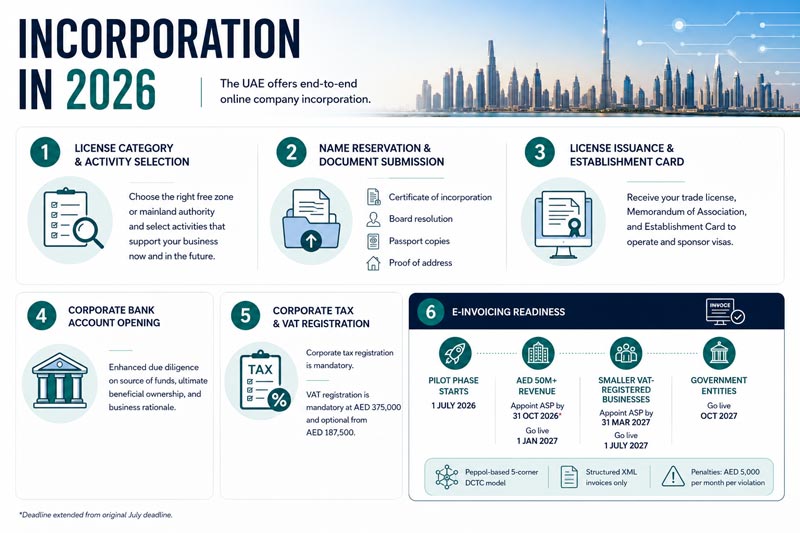
The UAE corporate tax regime has been in force since June 2023, with significant procedural refinements taking effect in 2026. For Australian firms structuring Asia operations through the UAE, the planning opportunities sit across five structures:
| Structure | Headline tax rate | Qualifying income treatment | Key considerations |
| Free Zone (QFZP) | 0% on qualifying income; 9% on non-qualifying | Income from foreign customers, other free zone entities, and qualifying activities | Must maintain adequate substance, meet the de minimis test, comply with transfer pricing rules, and avoid a mainland trading election |
| Mainland LLC | 0% up to AED 375,000; 9% above | All trading income within scope | Suitable where UAE domestic market access is the priority; Small Business Relief applies below AED 3 million through 2026 |
| DIFC / ADGM holding | 0% on qualifying dividend and capital gains income (where QFZP conditions are met) | Participation exemption available | Well-suited to holding downstream ASEAN and China investments |
| Branch office | 9% on UAE-attributable profits | N/A | Treated as a permanent establishment of the Australian parent |
| Large MNE groups | 15% Domestic Minimum Top-up Tax (DMTT) from January 2025 | Applies to in-scope multinationals with consolidated revenue of EUR 750 million or more | Implements OECD Pillar Two GloBE rules in the UAE |
Withholding tax on cross-border payments (dividends, interest, royalties, and service fees) remains at 0 percent at the UAE level. This is structurally significant when channeling income from ASEAN or Chinese subsidiaries up through a UAE holding entity.
The UAE has DTTs in force with every major Asian destination of interest to Australian firms: China, India, Singapore, Malaysia, Indonesia, Thailand, Vietnam, the Philippines, Japan, South Korea, Hong Kong, and Bangladesh. These generally provide reduced withholding rates on outbound payments from those jurisdictions to a UAE recipient. The Australia-UAE DTT, in force since 2013, provides the upstream layer for repatriating UAE profits to the Australian parent.
The interaction between the Australia-UAE DTA, the UAE’s Asian treaty network, and Australian controlled foreign company (CFC) rules requires careful structuring. The UAE entity needs sufficient economic substance to access treaty benefits under the relevant principal purpose tests, and the structure as a whole needs to withstand scrutiny under Australia’s anti-avoidance framework.
One further 2026 development is worth flagging. From April 14, 2026, the UAE’s administrative penalty framework was overhauled under Cabinet Decision No. 129 of 2025. The previous 2 percent day-one plus 4 percent monthly structure was replaced with a flat 14 percent annual rate accrued monthly on outstanding tax. The voluntary disclosure penalty was reduced to 1 percent per month. For cross-border groups managing complex compliance positions, this is a meaningful improvement.
Choosing the right emirate and free zone
The choice between emirates and free zones has direct implications for how Asian operations are structured.
| Emirate / free zone cluster | Best suited for | Key advantages | Key considerations |
|---|---|---|---|
| Dubai | Trading, logistics, services, and regional headquarters | DMCC and JAFZA support physical goods flows; DIFC supports financial services and holding structures; Emirates and flydubai provide strong connectivity across Asia | Must maintain adequate substance, meet the de minimis test, comply with transfer pricing rules, and avoid a mainland trading election |
| Abu Dhabi | Energy, advanced manufacturing, AI, and sovereign-adjacent business | ADGM offers a common-law jurisdiction; KIZAD supports manufacturing and re-export; Abu Dhabi is central to the CEPA-linked Investment Cooperation MOUs | Suitable where UAE domestic market access is the priority; Small Business Relief applies below AED 3 million through 2026 |
| Sharjah, Ras Al Khaimah, and Fujairah | SMEs, light manufacturing, holding structures, and Indian Ocean-linked trade | Lower operating costs; RAK ICC is used for holding structures; Fujairah supports Indian Ocean shipping routes | Well-suited to holding downstream ASEAN and China investments |
| China-facing supply chain clusters | Firms with Chinese supply chain exposure | DMCC, JAFZA, and Dragon Mart offer the strongest local ecosystems for China-linked trading and distribution | Treated as a permanent establishment of the Australian parent |
Conclusion
For a growing number of Australian firms, the UAE is no longer a side market but the entry point to the rest of Asia. CEPA matters, but it is not the whole story. The harder advantages are structural: the 0 / 9 percent corporate tax split, more than 140 double tax treaties, no withholding on outbound payments, and a legal environment Australian counsel can read without a translator.
The timing question matters more than the location one. Building a UAE holding and operating layer after ASEAN, Indian, or Chinese subsidiaries are already running is possible, but rarely cheap and almost never quick. With Australia-GCC FTA talks back on DFAT’s agenda, firms that move early will have the structure in place before the next wave arrives.
About Us
Middle East Briefing is one of five regional publications under the Asia Briefing brand. It is supported by Dezan Shira & Associates, a pan-Asia, multi-disciplinary professional services firm that assists foreign investors throughout Asia, including through offices in Dubai (UAE). Dezan Shira & Associates also maintains offices or has alliance partners assisting foreign investors in China (including the Hong Kong SAR), Indonesia, Singapore, Malaysia, Mongolia, Japan, South Korea, Nepal, The Philippines, Sri Lanka, Thailand, Italy, Germany, Bangladesh, Australia, United States, and United Kingdom and Ireland.
For a complimentary subscription to Middle East Briefing’s content products, please click here. For support with establishing a business in the Middle East or for assistance in analyzing and entering markets elsewhere in Asia, please contact us at dubai@dezshira.com or visit us at www.dezshira.com.